August 28, 1986
prohibits the manufacturing, importing and selling of ammunition that can penetrate a bulletproof vest.
About the Law Enforcement Officers Protection Act
The armor-piercing ammunition law commonly called the Law Enforcement Officers Protection Act was enacted as Public Law 99-408 (H.R. 3132) and signed by President Ronald Reagan on August 28, 1986. Responding to concerns about so-called cop-killer bullets that could defeat the soft body armor worn by police, it banned the manufacture and importation of armor-piercing handgun ammunition and restricted its sale by licensees, except for government use, export or authorized testing. The bill was endorsed by major police organizations, including the International Association of Chiefs of Police and the Fraternal Order of Police.
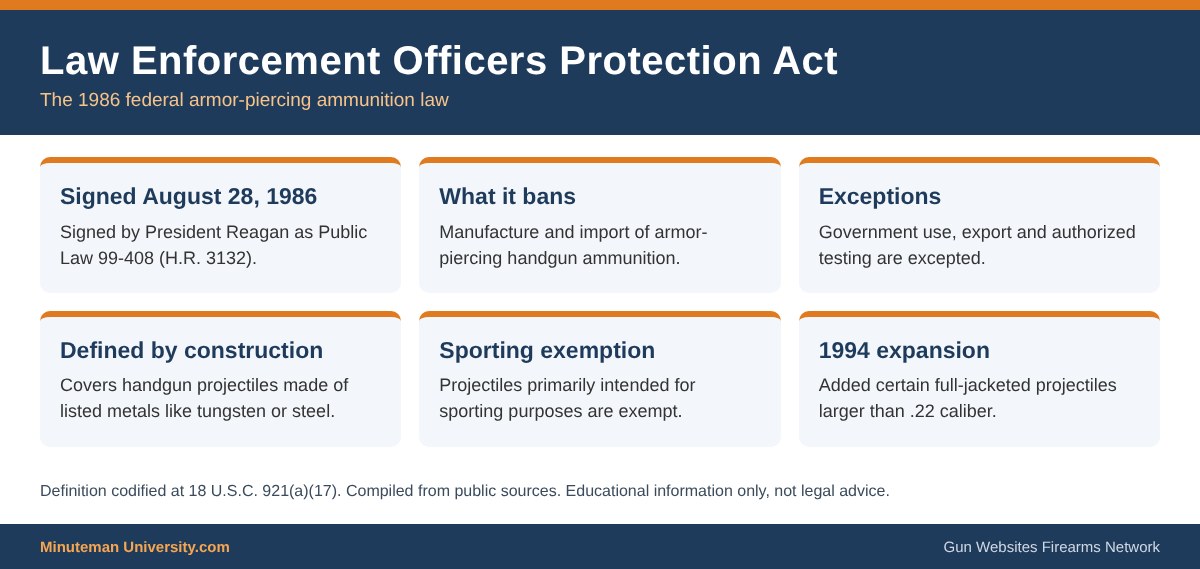
The 1986 law defined armor-piercing ammunition by construction rather than performance: a projectile or projectile core that may be used in a handgun and is made entirely from tungsten alloys, steel, iron, brass, bronze, beryllium copper or depleted uranium. Projectiles primarily intended for sporting purposes are exempt. Congress expanded the definition in 1994 to include certain full-jacketed projectiles larger than .22 caliber. The definition is codified at 18 U.S.C. 921(a)(17) and continues to shape which rifle and pistol ammunition licensed dealers can import and sell.
Key Facts
- August 28, 1986 – Signed by President Reagan as Public Law 99-408
- December 1, 1986 – Licensing provisions for manufacturers and importers take effect
- 1986 – ATF issues an initial list of ten projectile types classified as armor piercing
- 1994 – Definition expanded to cover certain jacketed projectiles larger than .22 caliber