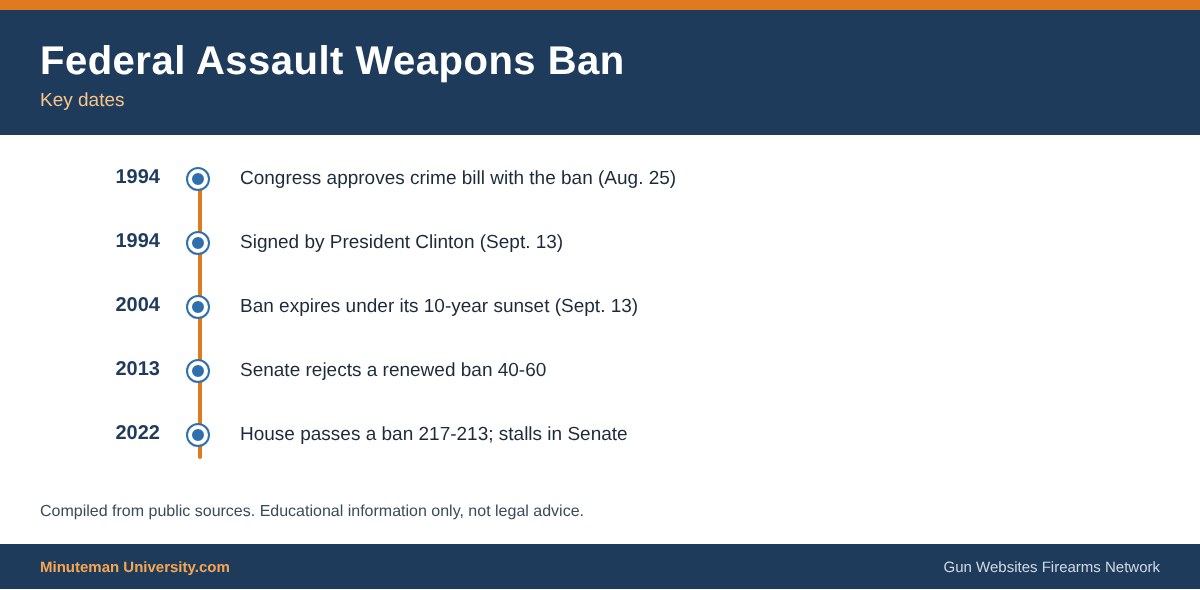
given final passage by the US Congress on August 25, 1994,
signed into law by US President Bill Clinton on September 13, 1994
expired on September 13, 2004
About the Federal Assault Weapons Ban
The Federal Assault Weapons Ban, formally the Public Safety and Recreational Firearms Use Protection Act, was Subtitle A of Title XI of the Violent Crime Control and Law Enforcement Act of 1994. Congress gave final approval to the crime bill on August 25, 1994, and President Bill Clinton signed it on September 13, 1994. The ban prohibited the manufacture, transfer and possession of newly made semi-automatic firearms defined as assault weapons, either by name or by a features test, such as a rifle that accepted a detachable magazine and had two or more listed features like a folding stock, pistol grip, bayonet mount or flash suppressor. It also banned the manufacture of new magazines holding more than ten rounds for civilian sale.
Firearms and magazines lawfully possessed before the law took effect were grandfathered, which created a market for pre-ban items, and manufacturers adapted by releasing post-ban models without the listed features. The ban carried a ten-year sunset and expired on September 13, 2004, after Congress declined to renew it. Later federal proposals, including a 2013 Senate bill that failed 40-60 and a 2022 House bill that stalled in the Senate, did not become law. The AR-15 has since become one of the most popular rifles in America.
Key Facts
- August 25, 1994 – Congress gives final approval to the crime bill containing the ban
- September 13, 1994 – Signed into law by President Bill Clinton
- September 13, 2004 – Ban expires under its ten-year sunset
- April 17, 2013 – Senate rejects a renewed ban 40-60
- July 29, 2022 – House passes a new ban 217-213; it stalls in the Senate