Gun owners leave a data trail. Opsec keeps it under control.
Internet Privacy: Online Security and Opsec for Gun Owners
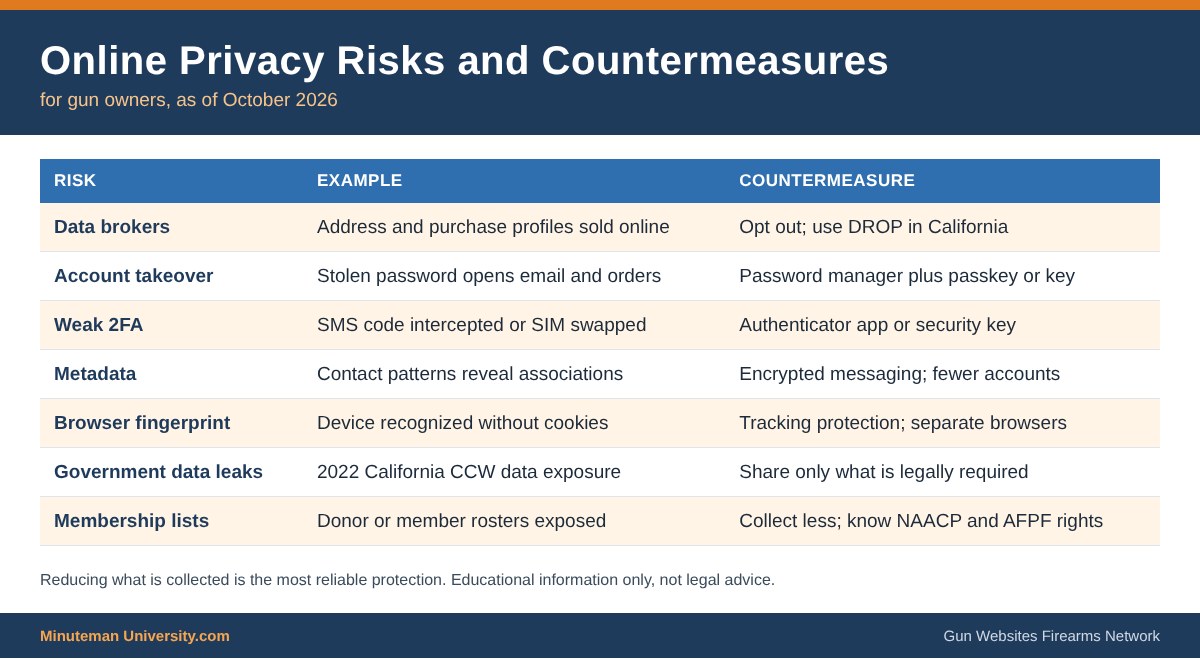
Gun owners generate a steady trail of data: online ammunition and accessory orders, range memberships, carry permit records, forum posts, club rosters, donations to advocacy groups and location history from phones. Data brokers buy and combine records like these into profiles that are sold for marketing, background screening and people-search sites. Once collected, data tends to outlive the reason it was gathered, and it can leak. In June 2022 the California Department of Justice’s Firearms Dashboard update exposed names, birth dates, addresses and license numbers of people granted or denied a concealed carry permit from 2011 to 2021; the data was online for less than 24 hours, but it could not be recalled.
Privacy of association also has deep legal roots. In NAACP v. Alabama (1958) the Supreme Court unanimously held that a state could not force the NAACP to turn over its membership lists, because exposure would chill the freedom to associate. In Americans for Prosperity Foundation v. Bonta (July 1, 2021) the Court struck down California’s requirement that charities file their major donors’ names with the state Attorney General. Both rulings matter to 2A organizations, whose member and donor lists are among their most sensitive assets.
Good privacy is less about secrecy than about reducing what is collected, protecting accounts, and keeping unrelated parts of life separate. The topics below, from metadata and browser fingerprints to speech-to-text, are covered in more detail on the linked pages.
Key Facts
- Metadata: who contacted whom, when and from where can reveal relationships even without message content.
- Browser fingerprinting and IP addresses can identify a device across sites without cookies.
- California’s DROP platform: under the Delete Act, California residents can send one deletion request to all registered data brokers; brokers must begin processing requests on August 1, 2026 and check the system at least every 45 days.
- Phishing-resistant MFA: CISA recommends passkeys or security keys as the strongest form of two-factor authentication; SMS codes are the weakest.
What Gun Owners Should Know
- Turn on two-factor authentication for email, social, banking and any firearm retailer accounts; use an authenticator app, passkey or hardware key over text messages.
- Use a password manager and a unique password for every account.
- Opt out of major people-search and data broker sites, or use a state tool such as DROP where available.
- Keep firearm inventories, serial numbers and permit scans out of cloud photo libraries and email.
- Use separate email addresses and usernames for advocacy, purchases and personal life.
- Organizations should collect only the member data they need, restrict who can export it, and know their legal rights before handing lists to anyone.
Related guides: Browsers, eMail Apps, Mapping Apps and Speech Recognition. Court case background: Court Cases.
Sources
- California DOJ: Firearms Dashboard data exposure notice
- Supreme Court: Americans for Prosperity Foundation v. Bonta (2021)
- Justia: NAACP v. Alabama ex rel. Patterson (1958)
- California Privacy Protection Agency: DROP
- CISA: Multifactor Authentication
Information Centralization
Collected Information Uses
AI controlled to the individual level
Sig-Int
- Signal Intelligence
- Relationship Map
- Meta-Data
- Browser Fingerprint
- IP Address
Control of Information vs Knowledge
Privacy
Denial of ID Information
Phones without Google/Apple
Browser Fingerprints
Device Emissions (Device Fingerprinting)
Speech to Text AI = Don’t Use
Unique Tags (to the Individual)
– IP Address, Account Numbers
Elements
- Understanding algorithms
- Blockchain
- Active Surveillance vs. Mass Surveillance
- Behavioral Profiling
- Message Manipulation
- Individualized Attacks
- Our Data Will Outlive us