Hacking 2A: Applying Systems Architecture to Second Amendment Advocacy
In its original sense, a “hack” is a clever, efficient solution to a hard problem, the kind of shortcut engineers admire. This page uses the word that way. Advocacy projects, clubs and websites are systems: they have inputs (volunteers, money, research), processes (writing, organizing, testifying) and outputs (informed voters, better laws, new shooters). The pioneers who turned computing from a craft into a discipline left lessons that apply directly to building advocacy systems that keep working under pressure.
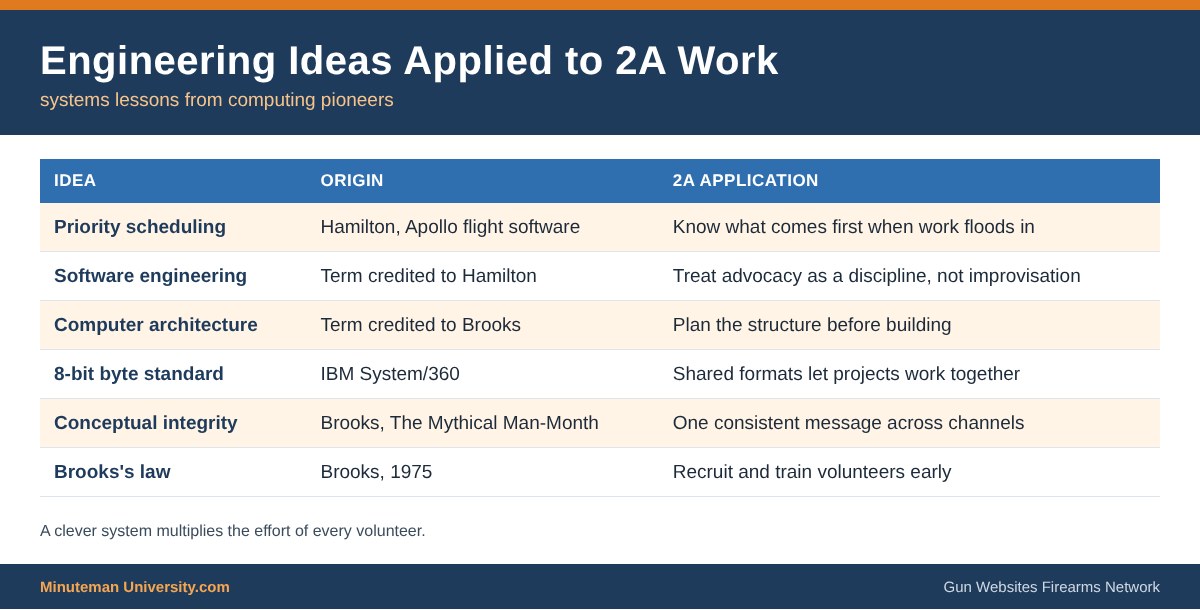
Two of those pioneers are noted below. Margaret Hamilton (1936 to 2026) directed the Software Engineering Division at the MIT Instrumentation Laboratory that built the flight software for the Apollo Guidance Computer, and she is credited with coining the term “software engineering.” During the Apollo 11 landing, the computer was overloaded with requests; the software shed lower-priority tasks and kept the landing-critical ones running. She received the Presidential Medal of Freedom in 2016 and died on September 30, 2026. Fred Brooks (1931 to 2022) managed IBM’s System/360 project, is credited with coining “computer architecture,” and called the move from a 6-bit to an 8-bit byte the most important single decision he ever made. His 1975 book The Mythical Man-Month gave the world Brooks’s law: adding manpower to a late software project makes it later.
Architecture Lessons for 2A Projects
- Design for overload (Hamilton): decide in advance which tasks come first when a bill hearing, news event or court ruling floods a group with work.
- Conceptual integrity (Brooks): a system is stronger when one consistent design runs through it; a project’s message, sources and style should match across every page and channel.
- Standards beat one-offs (the 8-bit byte): shared formats for citations, event listings and contact lists let separate projects work together.
- Brooks’s law: adding volunteers at the last minute can slow a campaign while they learn; recruit and train before the deadline.
- No single point of failure: keep content, contacts and backups on infrastructure the project controls, not only on one platform.
Practical Starting Points
- Write down the project’s purpose in one sentence and test every new page or event against it.
- Keep a simple, written process for recurring jobs (testimony, event posts, newsletters) so anyone can step in.
- Use templates and checklists; they are the advocacy version of reusable code.
- Review what worked after each campaign and change the system, not just the effort level.
Related: Creating a 2A Website, Levels of 2A Proficiency and Using Technology & the Internet. Network hub: Gun Websites.com.
Sources
- Margaret Hamilton (software engineer)
- MIT News: Margaret Hamilton receives Presidential Medal of Freedom
- ACM Turing Award: Frederick P. Brooks, Jr.
- Fred Brooks
Architecture
- Margret Hamilton
– First Software Engineer (as a discipline) - Fred Brooks
– First to term “Software Architecture”
– 8 bits (from 6 bits)