Last reviewed October 31, 2026
Protection of Lawful Commerce in Arms Act (PLCAA): Where It Stands in 2026
The PLCAA was Congress's answer to a wave of lawsuits filed in the late 1990s and early 2000s, when cities and private plaintiffs sued gun makers and dealers, often on public nuisance theories, seeking to hold them responsible for crimes committed by third parties with lawfully sold products. Supporters argued that such suits could bankrupt a lawful industry through litigation costs alone, regardless of outcome. Critics argued that the law gives the firearms industry a protection most other industries do not have. Congress passed the act in 2005 and President George W. Bush signed it on October 26, 2005.
The law requires courts to dismiss a "qualified civil liability action," meaning a suit against a manufacturer, distributor, dealer or trade association for harm caused by someone's criminal or unlawful misuse of a firearm or ammunition. It does not bar every case. Six exceptions in 15 U.S.C. 7903 allow suits for: knowingly transferring a firearm to be used in a violent or drug crime; negligent entrustment or negligence per se; knowingly violating a state or federal statute applicable to the sale or marketing of firearms when that violation was a proximate cause of the harm (the "predicate exception"); breach of contract or warranty; design or manufacturing defects when the product was used as intended; and enforcement actions by the U.S. Attorney General under the federal gun laws.
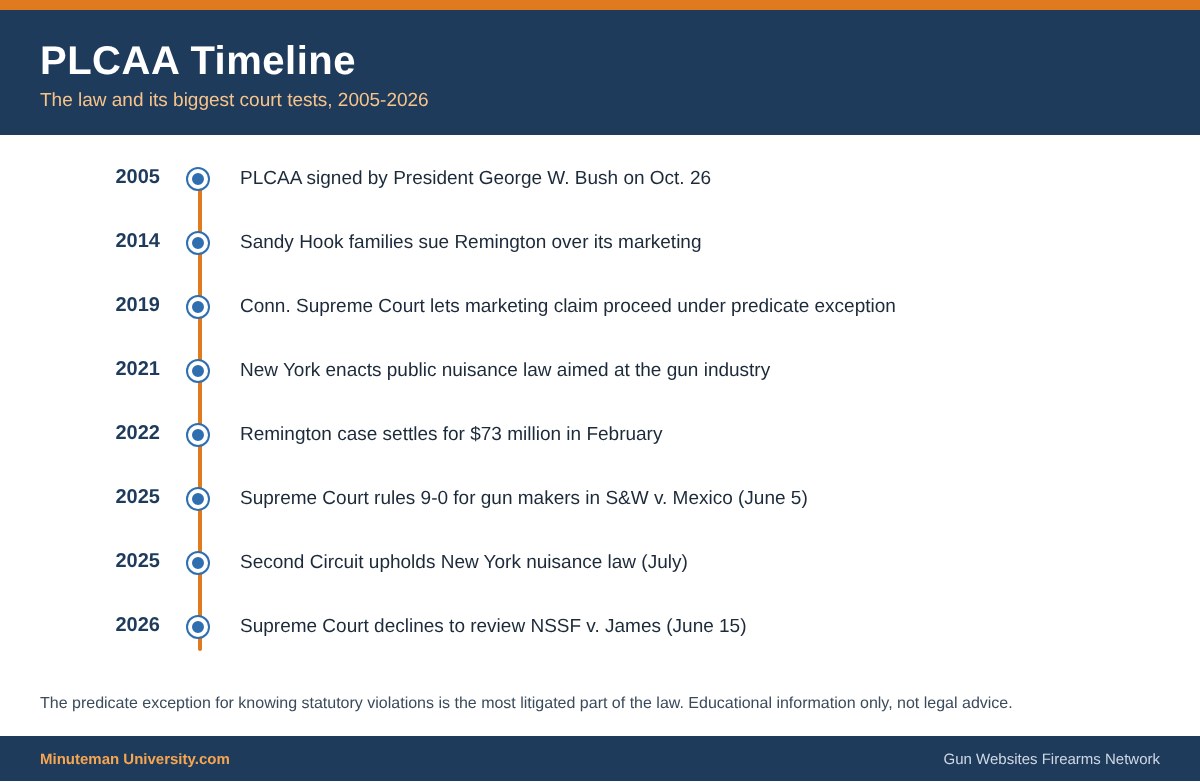
Most of the major cases since 2005 have been fights over the predicate exception. Families of Sandy Hook victims sued Remington under Connecticut's consumer protection law over its marketing; the case settled for $73 million in February 2022. In Smith & Wesson Brands v. Estados Unidos Mexicanos (June 5, 2025), the Supreme Court unanimously held that Mexico's $10 billion suit against U.S. gun makers was barred because Mexico had not plausibly alleged that the companies aided and abetted illegal sales. Meanwhile, New York's 2021 public nuisance law aimed at the industry was upheld by the Second Circuit in July 2025, and the Supreme Court declined to review it on June 15, 2026. Several other states have since passed similar laws, so more litigation is likely.
Key Facts
- Codified at 15 U.S.C. 7901-7903; signed October 26, 2005.
- Six statutory exceptions; the predicate exception is the most litigated.
- Sandy Hook families v. Remington settled for $73 million (2022) without a trial.
- S&W v. Mexico (2025) was decided 9-0, with Justice Kagan writing for the Court.
- New York's industry nuisance law survived a facial challenge; review was denied in June 2026.
What Gun Owners Should Know
- The PLCAA protects the businesses that make and sell firearms, which affects product availability and prices for owners.
- It does not protect a dealer who knowingly sells to a prohibited person or a maker of a defective product.
- State "industry responsibility" laws are the current route around PLCAA; watch for them in your state legislature.
- Bills to repeal or amend the PLCAA are introduced regularly in Congress.
Related: Commerce Clause, Court Cases, Federal Laws, Firearm Manufacturers, and network news at Gun Websites.com.
Sources
- 15 U.S.C. 7903: Definitions and Exceptions (Cornell LII)
- Congressional Research Service: Report R48715 on S&W v. Mexico
- Faegre Drinker: Supreme Court Decides S&W v. Mexico
- AmmoLand: Supreme Court Declines NSSF v. James (June 2026)
15 U.S.C. §§ 7901-7903
- Signed into law by President George W. Bush on October 26, 2005
United States law which protects firearms manufacturers and dealers from being held liable when crimes have been committed with their products
However, both manufacturers and dealers can still be held liable for damages resulting from defective products, breach of contract, criminal misconduct, and other actions for which they are directly responsible in much the same manner that any U.S. based manufacturer of consumer products is held responsible.