Media & Guns: How Firearms Are Covered in News and Entertainment
Most Americans form their picture of firearms from two places: news coverage and movies or television. Both shape public opinion, and public opinion shapes gun policy. For gun owners and 2A advocates, understanding how firearms coverage works, where it often goes wrong, and how to read it critically is a practical skill, not a grievance.
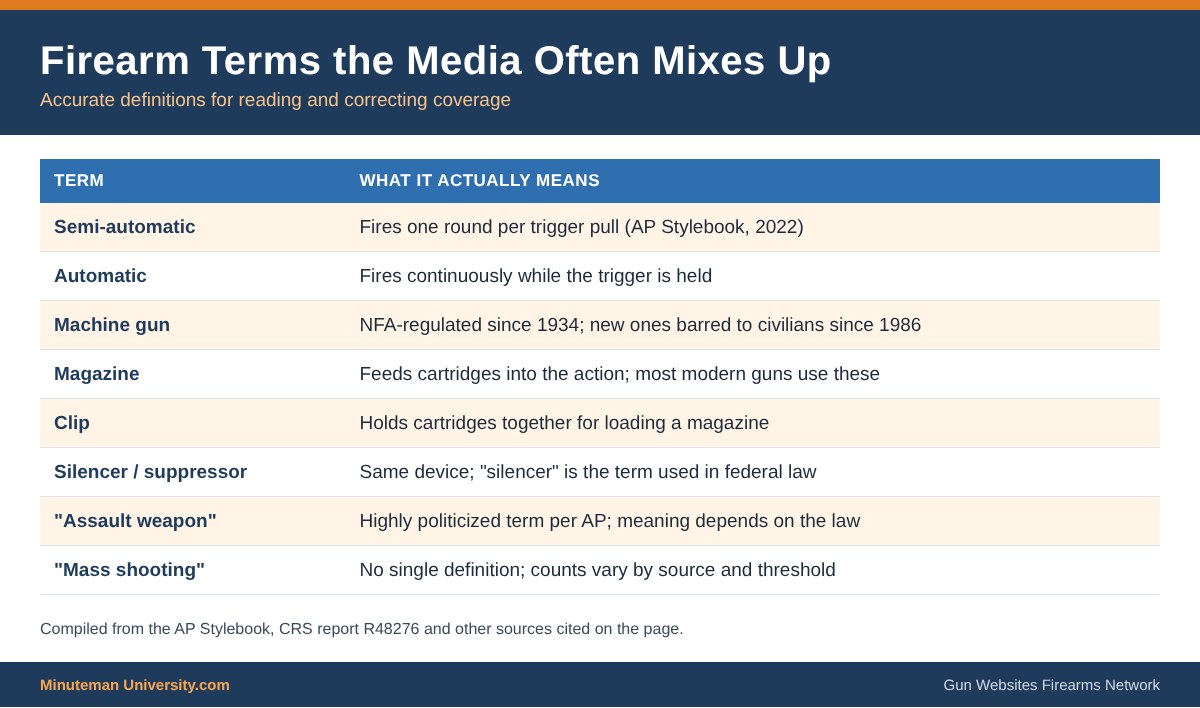
Many reporters cover firearms only when a crime or a policy fight is in the headlines, and many newsrooms have few staff with hands-on firearms experience. The result is a recurring set of terminology errors: confusing a semi-automatic rifle with a machine gun, calling a detachable magazine a “clip,” or treating “assault weapon” as a technical category when its meaning depends on which state or federal law is being discussed. These mistakes are usually the product of unfamiliarity rather than intent, and the professional standards bodies of journalism have tried to address them. In July 2022 the Associated Press Stylebook, which many U.S. newsrooms follow, advised journalists that “assault weapon” and “assault rifle” are highly politicized terms and that “semi-automatic” should be used for a rifle that fires one round per trigger pull, with “automatic” reserved for firearms that fire continuously while the trigger is held.
Entertainment presents a different challenge. Films and shows routinely depict suppressors as nearly silent, handguns as unlimited-capacity, and gunfights without legal consequences. Viewers who have never handled a firearm can come away with a distorted sense of how guns work and how the law treats their use. Suppressed gunshots remain loud, magazines run dry, and every round fired in self-defense is subject to legal review.
Minuteman University.com encourages a fair approach: correct errors with facts and sources, recognize journalists who get it right, and avoid assuming bad faith. Specialized outlets cover firearms policy from different perspectives, including The Reload and The Trace, and reading more than one source on the same story is the most reliable way to see the whole picture.
Key Facts
- July 2022: The AP Stylebook updated its weapons guidance, calling “assault weapon” and “assault rifle” highly politicized and defining “semi-automatic” (one round per trigger pull) versus “automatic” (continuous fire).
- Machine guns have been tightly regulated under the National Firearms Act since 1934, and new machine guns have been unavailable to civilians since the Firearm Owners Protection Act of 1986. Rifles commonly sold at retail are semi-automatic.
- “Mass shooting” has no single definition. A November 19, 2024 Congressional Research Service report (R48276) notes that the Gun Violence Archive counts incidents with four or more people shot (excluding the shooter) regardless of circumstances, while federal law (the Investigative Assistance for Violent Crimes Act of 2012) defines a “mass killing” as three or more deaths. The FBI’s “active shooter” reports use yet another standard. Totals reported in the news vary widely depending on which definition is used.
- Statutory language differs from common usage: federal law uses the word “silencer,” while the industry and most owners say “suppressor.” Both refer to the same device.
- “Clip” versus “magazine”: a magazine feeds cartridges into the action; a clip holds cartridges together for loading a magazine or certain fixed-magazine firearms. Most modern handguns and rifles use detachable magazines.
What Gun Owners Should Know
- Check the definition behind a number. When a story cites a count of shootings or “gun deaths,” look for the source and how it defines the term. Federal data from the CDC, for example, show that suicides make up a majority of U.S. firearm deaths; see the Firearm Deaths page.
- Go to the primary source. For laws, read the bill text or statute. For court rulings, read the opinion. The Court Cases page links major Second Amendment decisions.
- Correct errors politely and specifically. A short, sourced note to a reporter or editor (for example, pointing to the AP Stylebook definitions) is more likely to result in a correction than a hostile reply.
- Separate fiction from training. What works on screen does not reflect real-world marksmanship, use-of-force law or safe handling. Real instruction is available through qualified instructors; see After Action.net.
- Be a credible source. Gun owners who speak accurately and calmly about firearms are often the best counter to misinformation. Test knowledge with the quizzes at Tactical Quiz.com, and send firearms questions to Ask Gun Questions.com.
- Know the legal terms. Suppressor facts and myths are covered in depth at Suppressor Buyers Guide.com, and NFA definitions at NFA Buyers Guide.com.
Related Pages
Sources
- AP Reminds Journalists About Wording for Weapons (TSPR, July 2022)
- How to Define Mass Shootings: Potential Policy Implications (Congressional Research Service, R48276)
- National Firearms Act (ATF)