About Our Morals vs. Their Morals
People on different sides of the gun debate usually share the same goal of safety but weigh moral values differently. Social psychology offers a useful framework for understanding why. Moral Foundations Theory, first proposed by psychologists Jonathan Haidt and Craig Joseph in 2004, holds that human moral judgment draws on several intuitive foundations, commonly described as Care, Fairness, Loyalty, Authority and Purity. Haidt’s 2012 book The Righteous Mind popularized the theory and proposed a sixth foundation, Liberty, which centers on resistance to domination and coercion.
Research associated with the theory reports that people who identify as liberal tend to weigh Care and Fairness most heavily, that conservatives draw more evenly on all of the foundations, and that libertarians are most sensitive to Liberty. For gun rights advocates, this helps explain why an argument framed purely around individual liberty or constitutional limits may not land with someone whose primary moral lens is preventing harm, and why gun control arguments framed purely around harm may not move a listener focused on self-reliance and freedom from coercion. Effective communicators can show how firearm ownership also serves Care, by protecting family and community, and Fairness, by giving vulnerable people equal means of self-defense. The theory has critics who question some of its claims, so it is best used as a conversation tool, not a final verdict on anyone’s character.
Key Facts
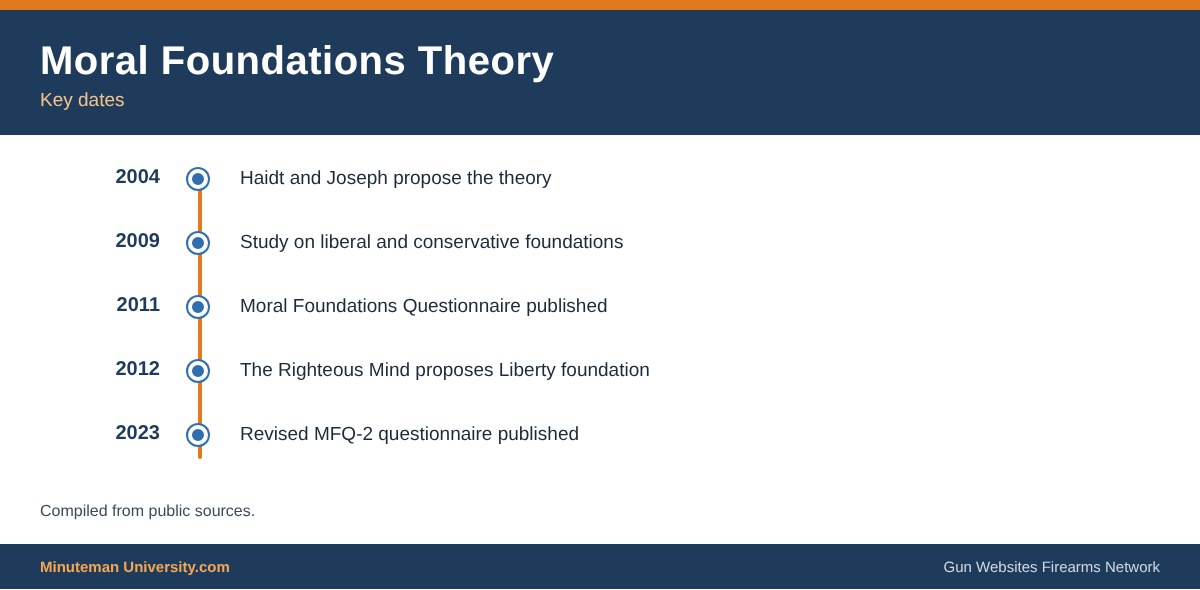
- 2004: Haidt and Joseph first propose Moral Foundations Theory in Daedalus
- 2009: Graham, Haidt and Nosek publish research on liberals and conservatives relying on different foundations
- 2011: Moral Foundations Questionnaire formally published
- 2012: The Righteous Mind popularizes the theory and proposes Liberty as a sixth foundation
- 2023: Revised MFQ-2 published, splitting Fairness into Equality and Proportionality