About Gun Colloquialisms
Firearms have shaped American English so thoroughly that many people use gun terms every day without realizing it. Most of these expressions date to the age of the flintlock, when the mechanics of loading and firing a muzzleloader were common knowledge. A flintlock has three main parts, the lock, the stock and the barrel, so buying something “lock, stock and barrel” came to mean taking the whole thing, a usage that took hold in the early 1800s. If the priming powder in the pan flashed without igniting the main charge, the result was a “flash in the pan,” a phrase now used for any promising start that fizzles. A noticeable delay between spark and shot was “hanging fire,” which still describes something stalled or undecided.
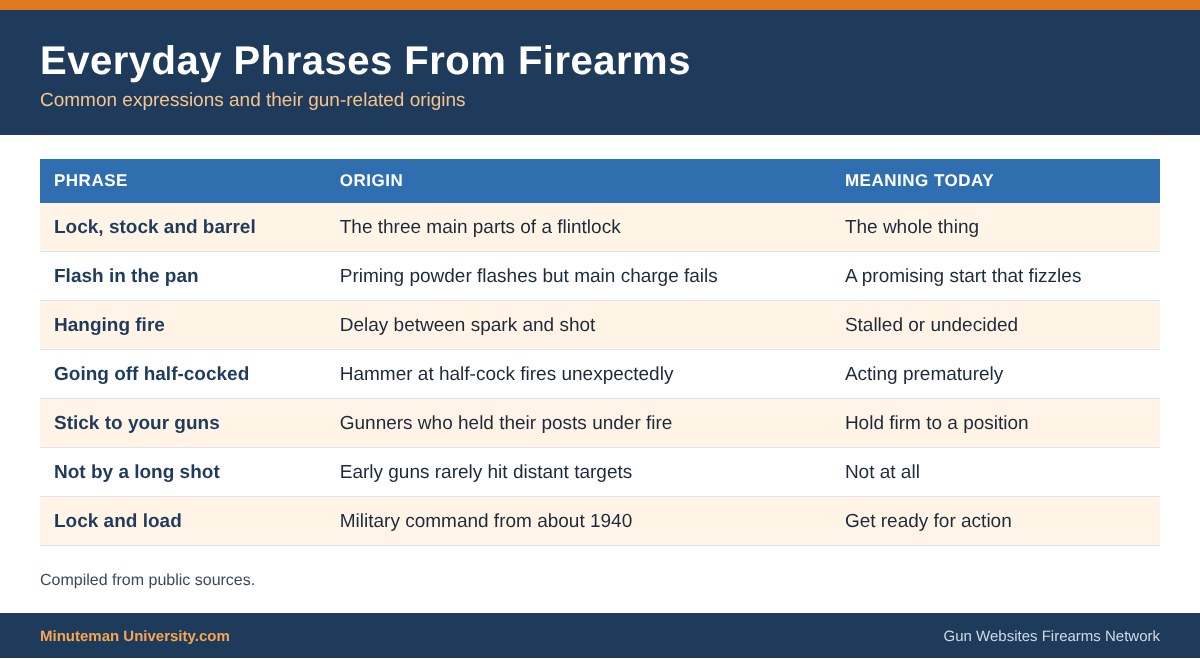
Other phrases come from later firearms and from military life. A hammer resting at half-cock could slip and fire unexpectedly, which gave us “going off half-cocked” for acting prematurely, a usage dating to the early 1700s. Gunners who stayed at their posts under fire “stuck to their guns,” used figuratively since the mid-1800s. “Not by a long shot” recalls how rarely early guns hit distant targets, and “lock and load,” a command dating to about 1940, now means getting ready for action of any kind. Knowing these origins is a small reminder of how deeply firearms are woven into American history.
Key Facts
- Early 1700s: “Going off half-cocked” in use, from the half-cock hammer position
- Early 1800s: “Lock, stock and barrel” comes to mean “the whole thing”
- Mid-1800s: “Stick to one’s guns” used figuratively
- Late 1800s: “Not by a long shot” and “like a shot” enter common use
- About 1940: “Lock and load” appears as a military command
Sources
Profiles on Minuteman University.com are editorial content compiled from public sources. Inclusion does not imply endorsement of, sponsorship by, or affiliation with this site or the Gun Websites Firearms Network. Corrections and removal requests are welcome through Contact Us.