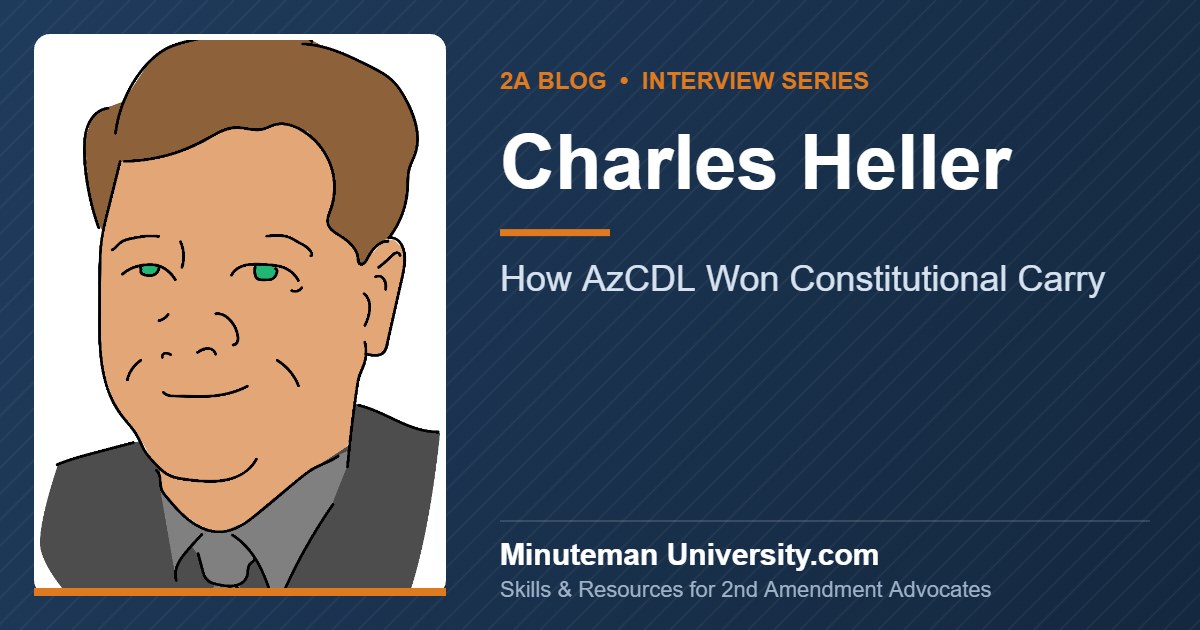
Charles Heller is a Tucson talk radio host, concealed carry instructor and one of the four co-founders of the Arizona Citizens Defense League (AzCDL). In this 2019 conversation for the Minuteman University interview series, he explains how a handful of volunteers with $1,200 built the organization behind Arizona’s presumption of reasonableness law and Constitutional Carry. For any 2A advocate who wants to change the law in their own state, it is a practical blueprint.
- Who: Co-founder and media coordinator of the Arizona Citizens Defense League; host of Liberty Watch Radio and America Armed & Free
- Known for: State-level carry reform in Arizona, Second Amendment talk radio, concealed carry instruction, former executive director of Jews for the Preservation of Firearms Ownership (JPFO)
- Interview: Minuteman University interview series, 2019
- Profile: Charles Heller on Minuteman University.com
From Chicago to Arizona: A Political Refugee for the Second Amendment
Heller grew up in Chicago, where his interest in firearms started early. His father had been a tank gunnery instructor during World War II at Fort Campbell and Fort Knox, and instead of children’s books he read his son naval and military history. That curiosity grew into years of reading gun magazines, then books on the right to keep and bear arms, including Stephen Halbrook’s That Every Man Be Armed.
In 1978 he left Illinois for Arizona. He describes himself as a political refugee for the right to keep and bear arms: in Chicago he could not legally carry a gun. His view of government has not changed since. Elected officials are the hired help, and it is not their place to tell free citizens what they may do with their liberty as long as they harm no one and damage no one’s property.
Four Volunteers, $300 Each
Arizona has long been a gun-friendly state, but by the early 2000s it had no truly activist gun lobby. An earlier grassroots group, Brass Roots, had won recognition from the Second Amendment Foundation before fading out. Heller and a group of fellow activists who had been talking online agreed to meet at a diner in Chandler, roughly halfway between Phoenix and Tucson. Eight people were interested at first. Four stayed.
What made the group work was a deliberate mix of skills. One founder was already a lobbyist for a motorcycle association. Another was a retired government executive with deep experience in organizational structure. A third was a seasoned activist and lobbyist. Heller brought media experience from his radio programs. Each put in $300, and that $1,200 launched the Arizona Citizens Defense League in 2005.
Heller also owns an advertising specialty business, so he ordered banners, bumper stickers, shirts and business cards at wholesale for the new group. When AzCDL set up its first tables at gun shows, it looked like an established organization. As Heller puts it, the group appeared substantial and soon became substantial.
The First Win: Restoring the Presumption of Reasonableness
AzCDL’s first bill passed in 2006. After a 1996 change pushed through by the prosecutorial lobby, Arizonans who used force in self-defense no longer had a presumption of reasonableness. Heller describes the result bluntly: a citizen who was attacked, called the police and explained what happened could expect to hear “you are under arrest.”
The 2006 law restored that presumption when force is used under Arizona’s justification statutes, covering self-defense, deadly force, defense of a third person, defense of premises and property, and defensive display, provided the defender reports to police as the victim. It was a precise fix to a specific problem, and it set the tone for everything that followed.
Constitutional Carry and 61 Bills Signed
Heller calls 2010 the group’s crowning achievement: Constitutional Carry. Arizonans no longer need a permit to carry concealed. In his words, where a gun is carried is a clothing choice, and no one should have to beg permission to exercise an individual, enumerated right protected by both the state and federal constitutions.
The permit was deliberately kept as an option so that residents keep reciprocity with other states and an easier path when buying a firearm. Along the way, the group also cut the required permit class from 16 hours to eight and reduced and then eliminated the renewal class. By the time of this interview, Heller counted 61 AzCDL bills signed by three governors over 14 years.
“You can compromise practice, but you can’t compromise principle.”
Charles Heller
That principle guided the Constitutional Carry bill. Requiring carriers to tell an officer they are armed when asked gave up nothing that court rulings had not already settled, so AzCDL accepted it to get a strong bill passed. Heller’s attitude toward reluctant officials is patient and firm: if one governor will not sign a bill, the next one will.
Teaching Concealed Carry in Context
Heller has taught Arizona concealed carry classes for decades, and the host credits him with going far beyond the minimum needed to qualify. His approach is to teach contextually, giving students a framework for how to listen and interpret, not just a list of rules.
His core message is that for a law-abiding citizen with good habits, the criminal is often not the biggest danger. A criminal can usually be deterred by making yourself a harder target than the next person. The greater risk is a mistake during a defensive encounter that pulls a responsible citizen into the legal system. His classes cover de-escalation, posture, body language and how to speak with people in authority. If police ask whether you are carrying, he recommends a calm, soft declaration such as telling the officer you have a permit and are carrying, with your hands folded in plain view.
The host adds advice of his own: take a CCW class as often as you can, and ask local instructors whether you can audit their classes to learn from different teachers.
Why He Stays Optimistic
Asked about the connection between gun control and racism, Heller points to the Jim Crow laws, where the first American gun control laws were used to keep Black citizens from defending themselves. He argues those laws are still enforced far more heavily against people of color and people of modest means.
He is optimistic about the long fight, and he has little patience for angry online venting that passes for activism. It persuades no one and can be used against gun owners later. Instead he approaches advocacy like a salesman: answer the objections, frame the choice clearly, and keep selling the idea of freedom.
“We never lose unless we quit. There’s no setback that can’t be recovered from.”
Charles Heller
He closes with an offer to activists elsewhere: anyone who wants to start an organization like AzCDL can get help with finances, lobbying and publicity, and can even ask for a copy of the group’s bylaws.
- A state organization does not need a big budget to start. It needs a small team with complementary skills: lobbying, organization, activism and media.
- Look professional from day one. Banners, shirts and business cards made a brand-new group look established at gun shows.
- Win specific, fixable problems first, like Arizona’s presumption of reasonableness, then build toward larger goals like Constitutional Carry.
- Never compromise principle, but be practical about details that cost nothing.
- Persuade instead of vent. Online anger wins no converts, while clear, calm arguments do.
Watch the full interview
Video: LIVE with Charles Heller from Arizona Citizens Defense League and Liberty Watch Radio on the Gun Websites YouTube channel.
- State Pro-Rights Organizations – find or support a group like AzCDL in your state
- District of Columbia vs. Heller – the landmark case, often confused with Charles Heller’s name
- Gun Control is Racist – the history behind the point Heller makes
- 2A Radio Hosts – more voices carrying the message on the air