1997
Ended the Brady Bill Burden to states
Argued December 3, 1996
Decided June 27, 1997
parts of the Brady Handgun Violence Prevention Act violated the Tenth Amendment to the United States Constitution.
About Printz v. United States
Printz v. United States, 521 U.S. 898 (1997), is the Supreme Court decision that struck down the Brady Act’s interim requirement that local chief law enforcement officers perform background checks on prospective handgun buyers. Before the FBI’s National Instant Criminal Background Check System came online in 1998, the Brady Act directed sheriffs and police chiefs to make a reasonable effort to determine whether a buyer was legally eligible. Two sheriffs challenged that mandate: Jay Printz of Ravalli County, Montana, and Richard Mack of Graham County, Arizona.
Writing for a 5-4 majority, Justice Antonin Scalia held that the federal government may not command state officers to administer or enforce a federal regulatory program, a principle known as the anti-commandeering doctrine, grounded in the Constitution’s structure of dual sovereignty and the Tenth Amendment. Justice Clarence Thomas wrote a concurrence noting the Second Amendment questions the case raised. The ruling did not strike down the Brady Act’s waiting period or the federal background check system itself, but it remains a key precedent for states and localities that decline to enforce federal firearms rules, including modern Second Amendment sanctuary measures.
Key Facts
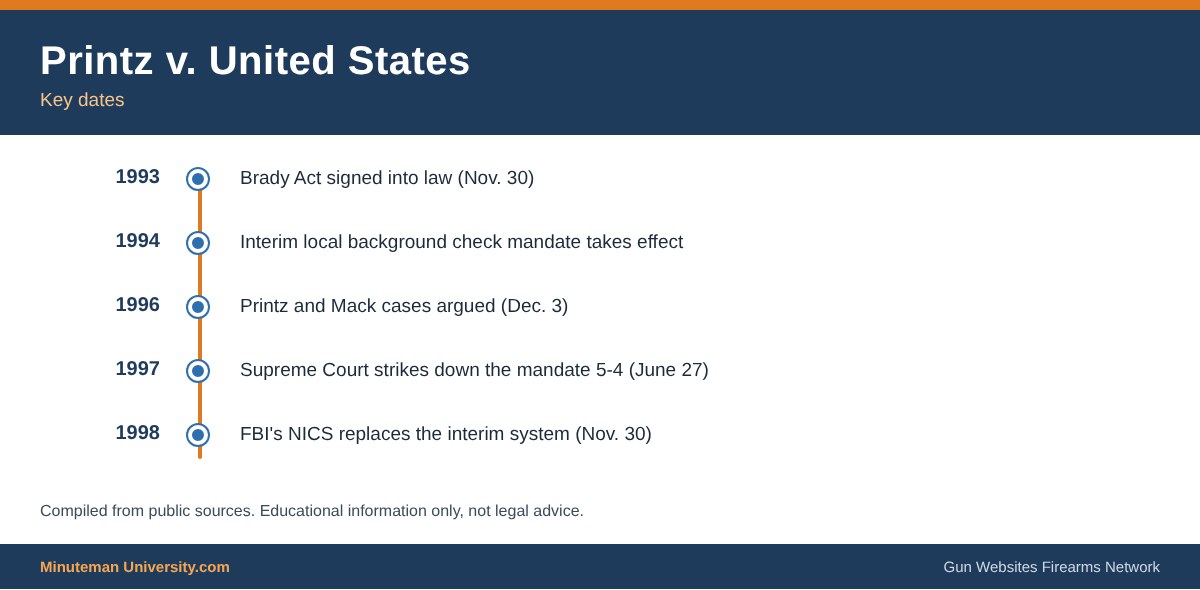
- November 30, 1993 – Brady Handgun Violence Prevention Act signed into law
- February 28, 1994 – Brady Act interim provisions take effect
- December 3, 1996 – Printz and Mack cases argued together
- June 27, 1997 – Decided 5-4; local background check mandate struck down
- November 30, 1998 – FBI’s NICS replaces the interim system
Learn More
Across the Gun Websites Network
- Printz v. United States (1997) on the calendar Gun Calendars.com