1895
Self-Defense requires No Duty to Retreat
- Supreme Court case where self-defense in a homicide case was found not to require a duty to retreat
About Beard v. United States
Beard v. United States, 158 U.S. 550 (1895), is the Supreme Court decision most often cited for the principle that a person who is lawfully on his own premises and is attacked has no duty to retreat before using force in self-defense. Babe Beard was convicted of manslaughter in the federal court for the Western District of Arkansas after a fatal confrontation near his home. The trial judge had instructed the jury that Beard was obligated to retreat if he could do so safely.
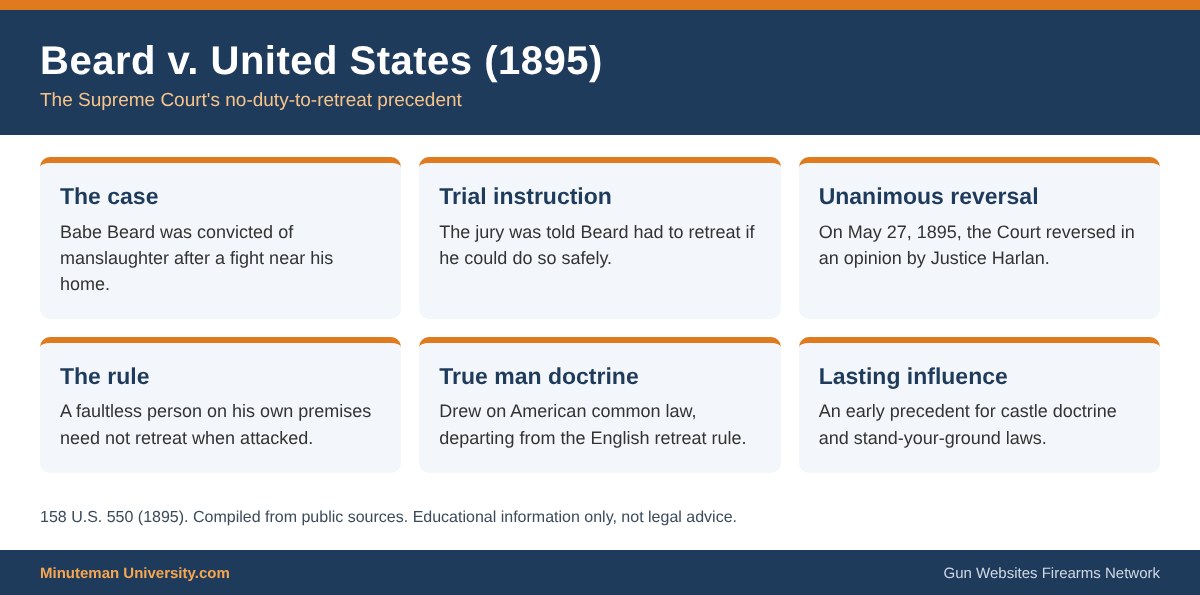
In a unanimous opinion by Justice John Marshall Harlan, decided May 27, 1895, the Court reversed the conviction. It held that a person who is without fault, on his own premises, and reasonably believes he faces death or great bodily harm is not obliged to retreat and is entitled to stand his ground. The decision drew on the so-called true man doctrine of American common law and departed from the stricter English retreat rule. For gun owners and armed citizens, Beard remains a cornerstone of American self-defense law and an early federal precedent for the castle doctrine and stand-your-ground principles now written into the statutes of many states.
Key Facts
- March 13, 1895 – Case submitted to the Supreme Court
- May 27, 1895 – Unanimous decision reverses Beard’s manslaughter conviction
- 1895 – Opinion by Justice John Marshall Harlan rejects a duty to retreat on one’s own premises
- 1921 – Brown v. United States reaffirms that a defender need not retreat when attacked