Last reviewed October 31, 2026
Gun Storage: Where It Stands in 2026
How a gun is stored is a personal decision that balances two duties: keeping firearms away from children and thieves, and keeping a defensive firearm ready when it is needed. The Supreme Court recognized that balance in District of Columbia v. Heller (June 26, 2008), striking down a D.C. law that required guns in the home to be kept disassembled or trigger-locked, because it made self-defense in the home impossible.
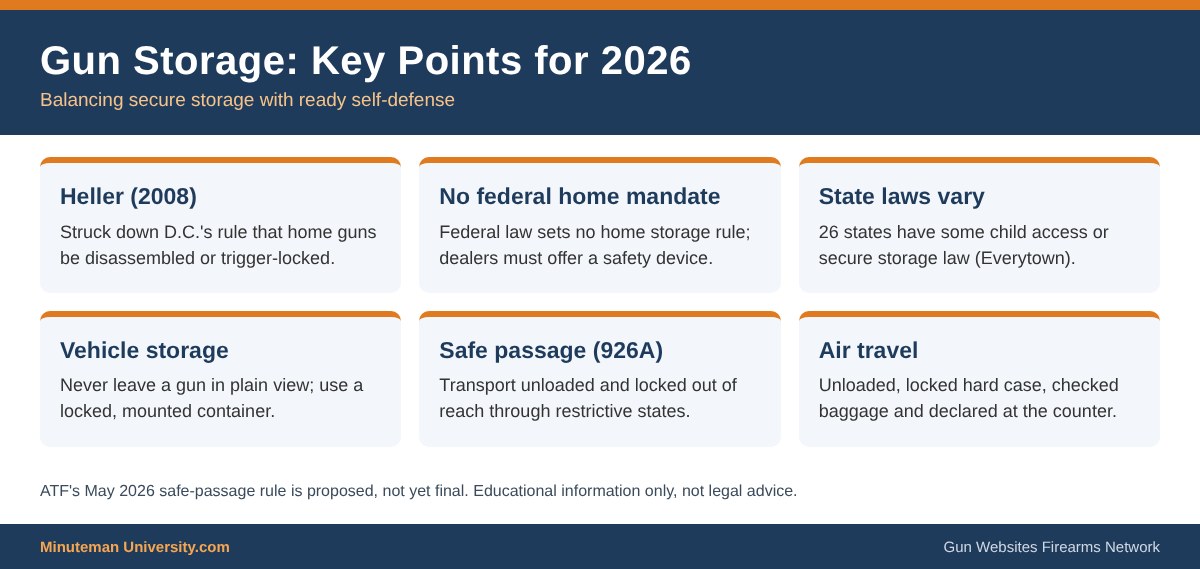
There is no federal law dictating how a private owner must store guns at home. Federal law does require licensed dealers to offer a secure storage or safety device with every handgun sale (18 U.S.C. 922(z)). Storage mandates come from the states. As of May 2026, Everytown counts 26 states with some form of child access prevention or secure storage law, most of them triggered only when a minor or prohibited person gets access. Massachusetts goes furthest, requiring every firearm not under the owner’s direct control to be locked. Vehicle storage rules also vary widely, and a growing number of states protect an employee’s right to keep a lawfully owned gun locked in a car in the workplace parking lot.
Travel got a major upgrade proposal in 2026. Under the Firearm Owners Protection Act’s safe-passage provision (18 U.S.C. 926A), a gun owner may transport an unloaded firearm, locked out of reach, through states where possession would otherwise be illegal. On May 6, 2026, ATF proposed a rule making clear that overnight lodging, food and fuel stops, vehicle maintenance and medical emergencies are part of protected “transport,” closing a gap that has led to arrests of travelers in restrictive jurisdictions.
Key Facts
- June 26, 2008: District of Columbia v. Heller struck down D.C.’s requirement that home firearms be disassembled or trigger-locked.
- 18 U.S.C. 922(z) requires dealers to offer a secure storage or safety device with each handgun transfer.
- As of May 2026, 26 states have some form of child access prevention or secure storage law (Everytown count; definitions vary).
- May 6, 2026: ATF proposed “Clarifying Interstate Transportation of Firearms” (Docket ATF-2026-0133, RIN 1140-AA73) to protect overnight stops and other incidental travel activity under 926A; comments closed in early August 2026. The rule is not yet final.
- As of June 2020, 24 states had some form of “parking lot” law protecting firearms locked in vehicles (Duke Center for Firearms Law).
What Gun Owners Should Know
- Check your state’s storage law, especially if children live in or visit your home, and see Guns & Kids.
- Quick-access safes and lockboxes allow both secure storage and fast access for home defense.
- Vehicles are a top source of stolen guns. Never leave a firearm in plain view, and use a locked, mounted container when the gun must stay in the car.
- When traveling, verify every state on the route. Under 926A, the firearm should be unloaded and locked in the trunk or, if the vehicle has no trunk, in a locked container other than the glove box or console. Ammunition must also be out of reach of the passenger compartment.
- For air travel, TSA requires firearms to be unloaded, locked in a hard-sided case, packed in checked baggage and declared at the airline counter. Short-barreled rifles and shotguns may still require ATF Form 20 for interstate travel; see NFA Buyers Guide.com.
- Document your collection with serial numbers and photos, and consider coverage on the Firearm Insurance page.
Across the Gun Websites Network
- Choosing a Gun Safe Gun Safe Buyers Guide.com
- Handgun Safes Gun Safe Buyers Guide.com
- Gun Safe F.A.Q. Gun Safe Buyers Guide.com
Sources
- Federal Register: Clarifying Interstate Transportation of Firearms under the Gun Control Act (NPRM, May 6, 2026)
- 18 U.S.C. 926A, Interstate Transportation of Firearms (Cornell Legal Information Institute)
- Duke Center for Firearms Law: Parking Lot Laws, Their Content and Applicability (June 2020)
- TSA: Transporting Firearms and Ammunition
- District of Columbia v. Heller (2008), Cornell Legal Information Institute
Background and Resources
Mandatory Storage Laws
Firearm Storage in Vehicles
Traveling with Firearms