Building Guns: How Firearms Are Made, Licensed and Regulated
Every firearm in the United States comes from one of three places: it is manufactured by a licensed maker, imported by a licensed importer, or built by a private individual for personal use. This section of Minuteman University.com covers the rules that apply to each path, from the federal licensing system that governs the industry to the home-built guns, 80% kits and 3D-printed designs that have become one of the most debated topics in firearm policy.
Federal licensing began with the Federal Firearms Act of 1938 and was rebuilt by the Gun Control Act of 1968, which still sets the rules for who must hold a Federal Firearms License (FFL). Anyone engaged in the business of manufacturing, importing or dealing firearms needs a license under 18 U.S.C. 923. Federal law does not require a license for a non-prohibited person to build a firearm for personal use, provided it is not made for sale and complies with the National Firearms Act and the Undetectable Firearms Act. Many states go further, and some now require serial numbers or registration for home-built guns or restrict unfinished frames and receivers.
The biggest recent change came from ATF’s frame or receiver rule, announced April 11, 2022 and effective August 24, 2022. It treats some partially complete frames and receivers and weapon parts kits as firearms that must be serialized and sold through an FFL with a background check. The Supreme Court upheld the rule against a facial challenge in Bondi v. VanDerStok on March 26, 2025, by a 7-2 vote. On the NFA side, the tax on making or transferring suppressors, short-barreled rifles, short-barreled shotguns and AOWs has been $0 since January 1, 2026, while machine guns and destructive devices remain fully regulated.
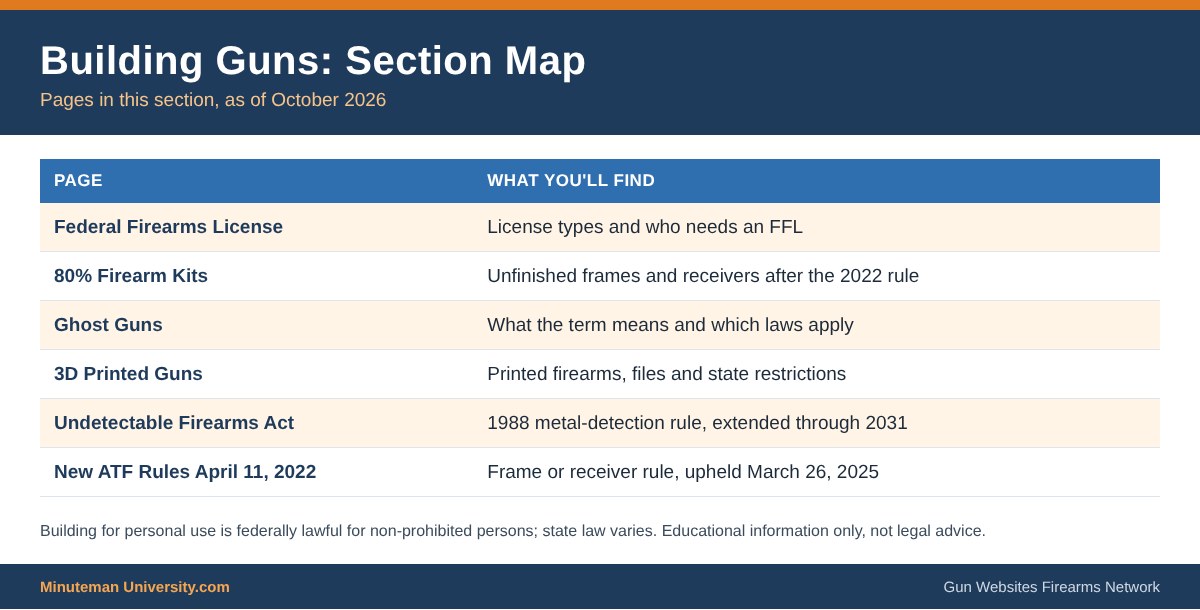
Pages in This Section
- Federal Firearms License: the license types, who needs one and how the FFL system works.
- 80% Firearm Kits: unfinished frames and receivers, and how the 2022 rule changed their sale.
- Ghost Guns: what the term means, how it is used in policy debates and which laws apply.
- 3D Printed Guns: printed frames and firearms, file distribution and state restrictions.
- Undetectable Firearms Act: the 1988 metal-detection requirement, extended through 2031.
- New ATF Rules April 11, 2022: the frame or receiver rule and its path to the Supreme Court.
What Gun Owners Should Know
- Building for personal use is federally lawful for people who can legally own a gun, but making firearms to sell requires a manufacturer’s license.
- Check state law first. A home build that is legal under federal law may be illegal or require a serial number in some states.
- Making an NFA item (suppressor, SBR, SBS, AOW) still has its own rules; see the National Firearms Act page and NFA Buyers Guide.com.
- Every firearm must remain detectable by a walk-through metal detector under the Undetectable Firearms Act, including printed guns.
- Federal authority over the industry rests largely on the Commerce Clause, which is why interstate commerce shows up in so many gun statutes.
Sources
- 18 U.S.C. 923, Licensing (Cornell LII)
- 18 U.S.C. 921, Definitions (Cornell LII)
- Federal Firearms Act of 1938 (Wikipedia)
- Undetectable Firearms Act (Wikipedia)
Where guns come from
- Made
- Imported
- Sold
Issues effecting creating firearms
- Commerce Clause
- National Firearms Act (NFA) 1934
– Suppressors
(Hunting with a Suppressor)
– Short Barrel Rifles (SBR)
(Pistol Braces)
– AOW & SBS
– Machine Guns & Destructive Devices - Federal Firearms License – 1939
- FFLs by State
- Gun Control Act – 1968
- Undetectable Firearms Act
- 80% Firearm Kits
- Ghost Guns
- 3D Printed Guns