International Firearms Issues: Where They Stand in 2026
The United States is unusual in protecting an individual right to keep and bear arms in its national constitution, but gun policy abroad still shapes the American debate. Laws in Canada, the United Kingdom and Australia are frequently cited as models by supporters of stricter laws and as warnings by gun-rights advocates, while Switzerland and the Czech Republic are often cited as examples of high civilian ownership within a regulated system. This page from Minuteman University.com summarizes the key facts in brief.
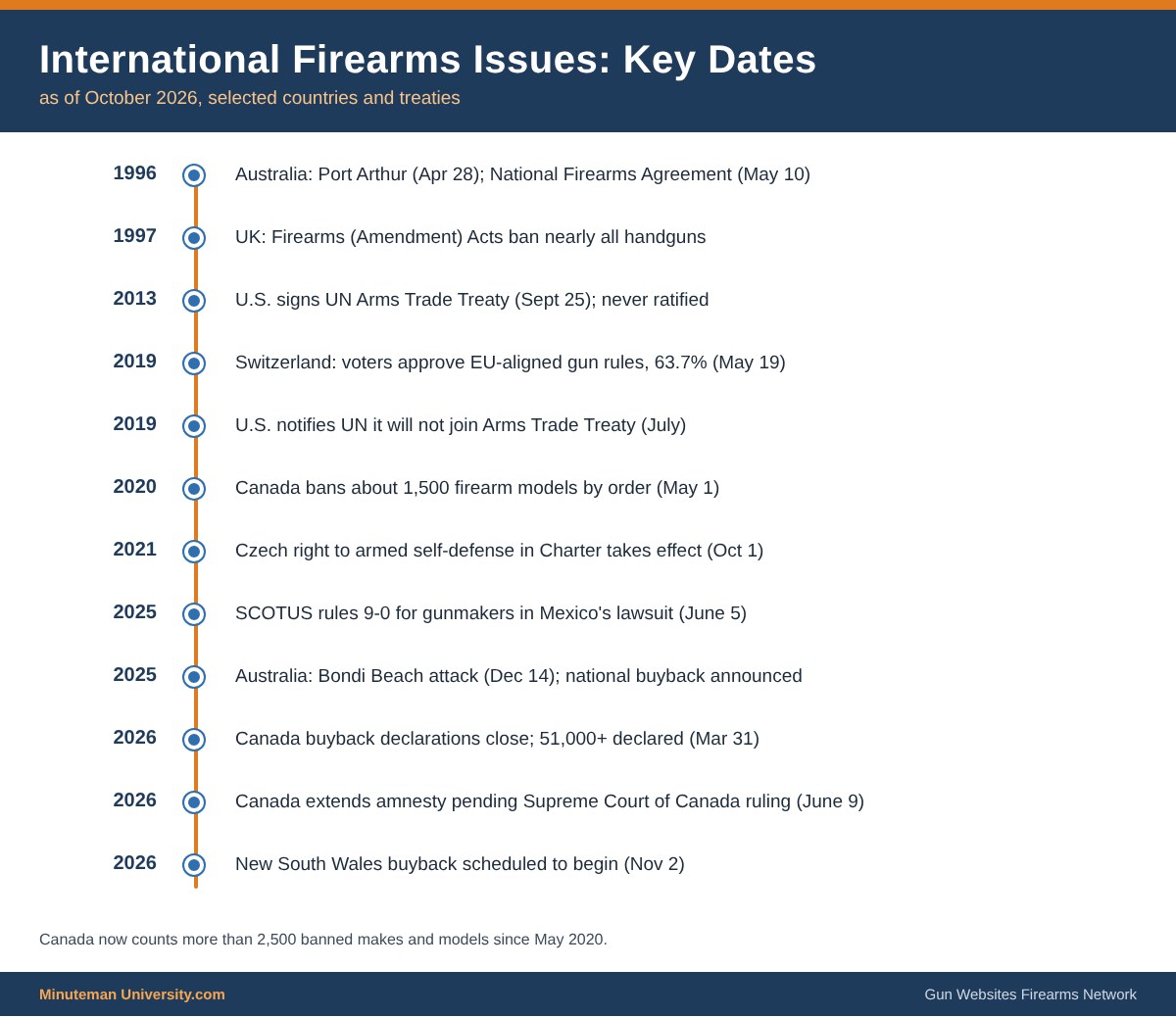
Canada banned about 1,500 models of what the government calls “assault-style” firearms by order in council on May 1, 2020, and has since added more; Public Safety Canada now counts more than 2,500 makes and models. The federal compensation program opened to individual owners in January 2026 and closed to new declarations on March 31, 2026, with officials reporting more than 51,000 firearms declared, against funding set aside for about 136,000. On June 9, 2026, Ottawa extended the amnesty to 90 days after the Supreme Court of Canada decides a challenge to the 2020 ban, which it agreed to hear in March 2026. The United Kingdom banned most semi-automatic centerfire rifles after the 1987 Hungerford shooting and, after the March 1996 Dunblane school shooting, banned nearly all handguns through two Firearms (Amendment) Acts in 1997. Australia adopted the National Firearms Agreement on May 10, 1996, after the April 28, 1996 Port Arthur shooting, with a buyback commonly cited at about 650,000 firearms. After the December 14, 2025 Bondi Beach attack, the federal government announced a new national buyback; New South Wales set its buyback, tied to a new four-firearm personal limit, to begin November 2, 2026.
Switzerland combines a militia tradition with licensing; on May 19, 2019, voters approved tighter rules aligned with the EU firearms directive by 63.7 percent. The Czech Republic amended its Charter of Fundamental Rights and Freedoms to guarantee the right to defend one’s own life or another’s “also with a weapon” under conditions set by law, in force October 1, 2021. Internationally, the UN Arms Trade Treaty regulates cross-border arms transfers between states; the U.S. signed it on September 25, 2013, never ratified it, and notified the UN in July 2019 that it does not intend to become a party. In Smith & Wesson Brands v. Estados Unidos Mexicanos (June 5, 2025), the U.S. Supreme Court unanimously held that the Protection of Lawful Commerce in Arms Act barred Mexico’s lawsuit against U.S. gunmakers. Supporters of foreign restrictions point to reduced mass shootings; critics argue the measures burden lawful owners and that the evidence on overall crime effects is mixed.
Key Facts
- May 1, 2020: Canada prohibited about 1,500 firearm models; more than 2,500 makes and models are banned as of 2026.
- March 31, 2026: Canada’s individual compensation program closed to new declarations; more than 51,000 firearms declared.
- June 9, 2026: Canada extended its amnesty until 90 days after a Supreme Court of Canada ruling.
- 1997: UK Firearms (Amendment) Acts banned nearly all handguns.
- May 10, 1996: Australia’s National Firearms Agreement; November 2, 2026: New South Wales buyback scheduled to begin.
- May 19, 2019: Swiss voters approved EU-aligned gun rules, 63.7 percent in favor.
- October 1, 2021: Czech constitutional right to defend life with a weapon took effect (Constitutional Act 295/2021).
- July 2019: U.S. formally notified the UN it will not ratify the Arms Trade Treaty.
- June 5, 2025: Supreme Court ruled 9–0 for U.S. gunmakers in Mexico’s lawsuit.
What Gun Owners Should Know
- Foreign laws do not apply in the U.S., but they are cited constantly in American policy debates; know the actual details and dates before discussing them.
- Traveling hunters and competitors must follow the destination country’s import and permit rules, plus U.S. export rules, well before departure.
- Canada’s rules remain in flux while its Supreme Court case is pending; check Public Safety Canada directly before crossing the border with any firearm.
- Compare foreign buybacks with U.S. proposals using Firearm Bans and State Gun Bans; for U.S. case law, see Court Cases.
- Follow 2A history dates at Gun Calendars.com and the wider Gun Websites.com network.