Everyday English is full of firearm history. These sayings make a friendly opening for a conversation.
Gun Expressions: Everyday Sayings with Firearm Roots
Many common English expressions began as plain descriptions of how muzzleloading guns worked. For two centuries the flintlock was the standard firearm, and its quirks, a spark that failed to light the main charge or a hammer that slipped from a safety notch, were familiar to nearly everyone. Those quirks became metaphors, and the metaphors outlived the guns. Today people say “lock, stock and barrel” or “flash in the pan” without knowing they are describing an 18th-century musket.
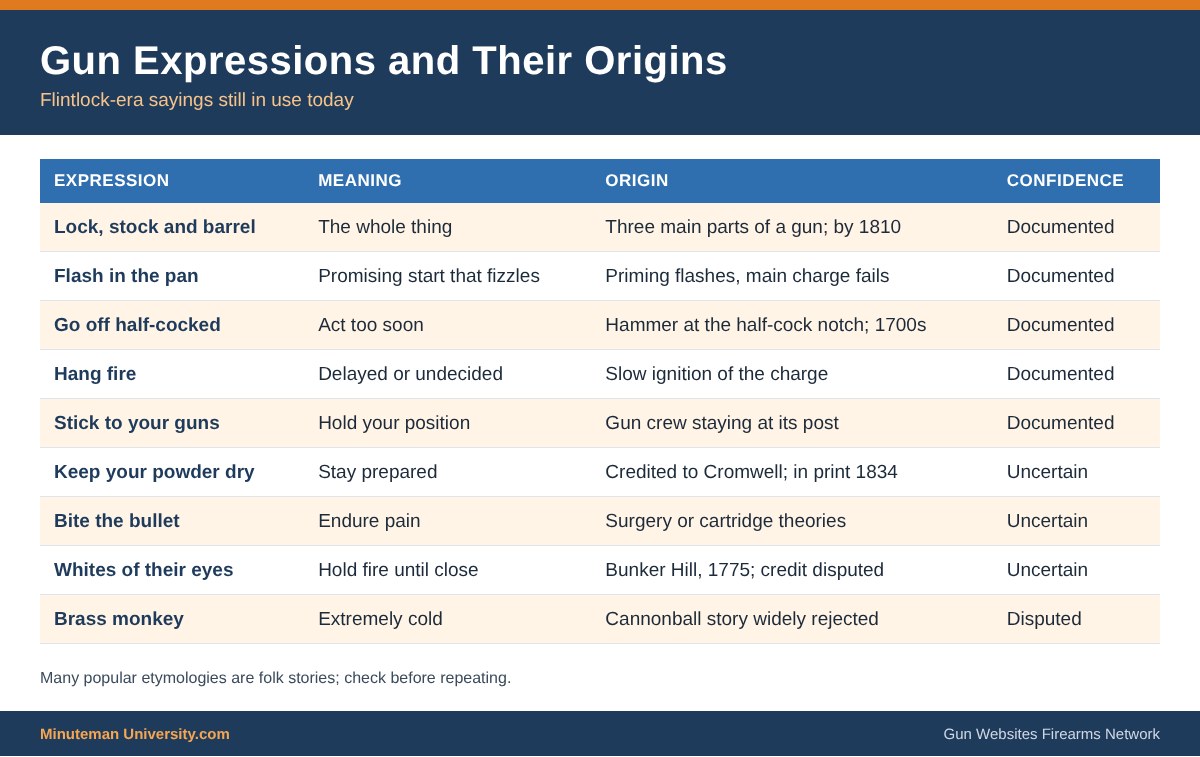
Not every gun-sounding saying has a gun origin, and not every popular explanation is true. Word historians have documented some origins well; others rest on guesswork. This page notes the difference. For example, “cold enough to freeze the balls off a brass monkey,” on the list below, is often explained as a shipboard rack for cannonballs, but word researchers widely reject that story, and the earliest known versions (from 1857) speak of a brass monkey’s tail or nose, which points instead to brass monkey figurines.
Expressions with Documented Firearm Origins
- Lock, stock and barrel: the whole thing. The lock (firing mechanism), stock and barrel are the three main parts of a gun. Print uses go back to at least 1810, and Walter Scott used it in an 1817 letter.
- Flash in the pan: a promising start that comes to nothing. On a flintlock, the priming powder in the pan could flash without firing the main charge.
- Go off half-cocked: to act before you are ready. The half-cock position was a safety notch; sources differ on whether the image is a gun firing unexpectedly from half-cock or one that would not fire at all. Recorded since the 1700s.
- Hang fire: to be delayed or undecided, from a slow ignition between spark and shot.
- Stick to your guns: to hold your position. Originally “stand to your guns,” a gun crew staying at its post; used figuratively since the mid-1800s.
- Not by a long shot: not at all, from the low odds of hitting at long range.
- Like a shot: very quickly, from the speed of a bullet.
Expressions with Uncertain or Disputed Origins
- Keep your powder dry: stay prepared. Attributed to Oliver Cromwell, but the attribution first appears in a poem published in 1834; treat it as uncertain.
- Bite the bullet: endure something painful. Often linked to battlefield surgery or to biting paper cartridges; neither is proven.
- Don’t shoot until you see the whites of their eyes: attributed to American officers at Bunker Hill (1775), with credit disputed between William Prescott and Israel Putnam; similar orders were used in European armies earlier.
- Give it your best shot: “shot” meaning an attempt dates to about 1750, so a firearm origin is doubtful.
- From my cold, dead hands: a pro-gun slogan made famous by Charlton Heston at the 2000 NRA annual meeting; the phrase circulated earlier.
Related Pages
- Gun Idioms
- Gun Phrases
- Firearm Quotes
- Firearm history events at Gun Calendars.com
Sources
- Word Histories: Lock, stock and barrel
- HistoryNet: Fighting Words, Surefire Cliches
- Wikipedia: Half-cock
- Lake Champlain Maritime Museum: Freeze the Balls off a Brass Monkey
An idiomatic way of expressing something in less literal, less familiar terms
- Can’t hit the broad side of a barn
- Cold enough to freeze the balls off a brass monkey
- Don’t shoot until you can see the whites of their eyes
- Faster than a speeding bullet
- Like Shooting Fish in a Barrel
- Live by the gun. Die by the gun.
- From my cold dead hands