Ask how they know, not why they are wrong.
Do not argue about the conclusion.
Talk about how the conclusion was reached.
Questions open doors that facts alone cannot.
Street epistemology is a conversation technique built around one question: “How do you know that?”
Instead of trading statistics, both people look at how confident a belief is and what it is based on.
It was introduced by philosopher Peter Boghossian in 2013 and refined by practitioners who record and review real conversations.
Why It Works for 2A Conversations
It lowers defenses
A question about reasons feels like curiosity, not an attack. People explain instead of defending.
It exposes the gaps
Many strong opinions about gun laws rest on a headline or a single story. Asked gently, people notice that for themselves.
It works both ways
Applying the same questions to your own beliefs makes your arguments stronger and more honest.
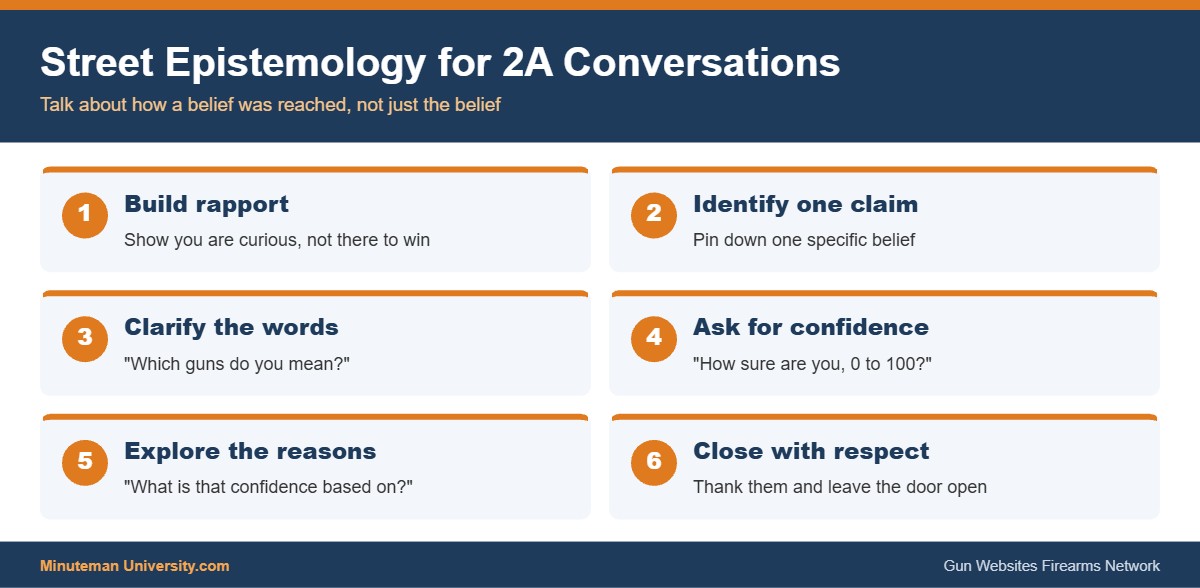
The Six Core Moves
A Sample Exchange
Notice what did not happen: no statistics, no raised voices, no winner.
The listener found the open question on their own, which is the kind of change that lasts.
Do’s and Don’ts
Stay curious and genuinely ask.
Use questions as a trap. People can tell.
Focus on one claim at a time.
Jump between five topics in five minutes.
Accept “I am not sure” as progress.
Push for a confession or a reversal on the spot.
Ask yourself the same questions about your own views.
Assume you are the only one with good reasons.
- 2A Conversation Skills – the full learning path and the CALM Method
- Conversation Trainer – practice with twelve real scenarios
- Words Matter – accurate language that keeps the focus on the criminal
- Peter Boghossian, A Manual for Creating Atheists (Pitchstone Publishing, 2013), the book that introduced the term
- Street Epistemology International: Introduction to Street Epistemology
- Fernbach and others, “Political Extremism Is Supported by an Illusion of Understanding,” Psychological Science (2013)