Win the conversation, not just the argument.
Most minds are not changed by winning an argument.
They are changed by a conversation that felt fair.
This is the training ground for having more of those conversations.
Every gun owner ends up in the debate sooner or later: at work, at a family dinner, online, or on a microphone.
The goal here is simple. Speak accurately, stay calm, ask good questions and leave people thinking.
Start with the method, follow the path in order, then test yourself in the Conversation Trainer.
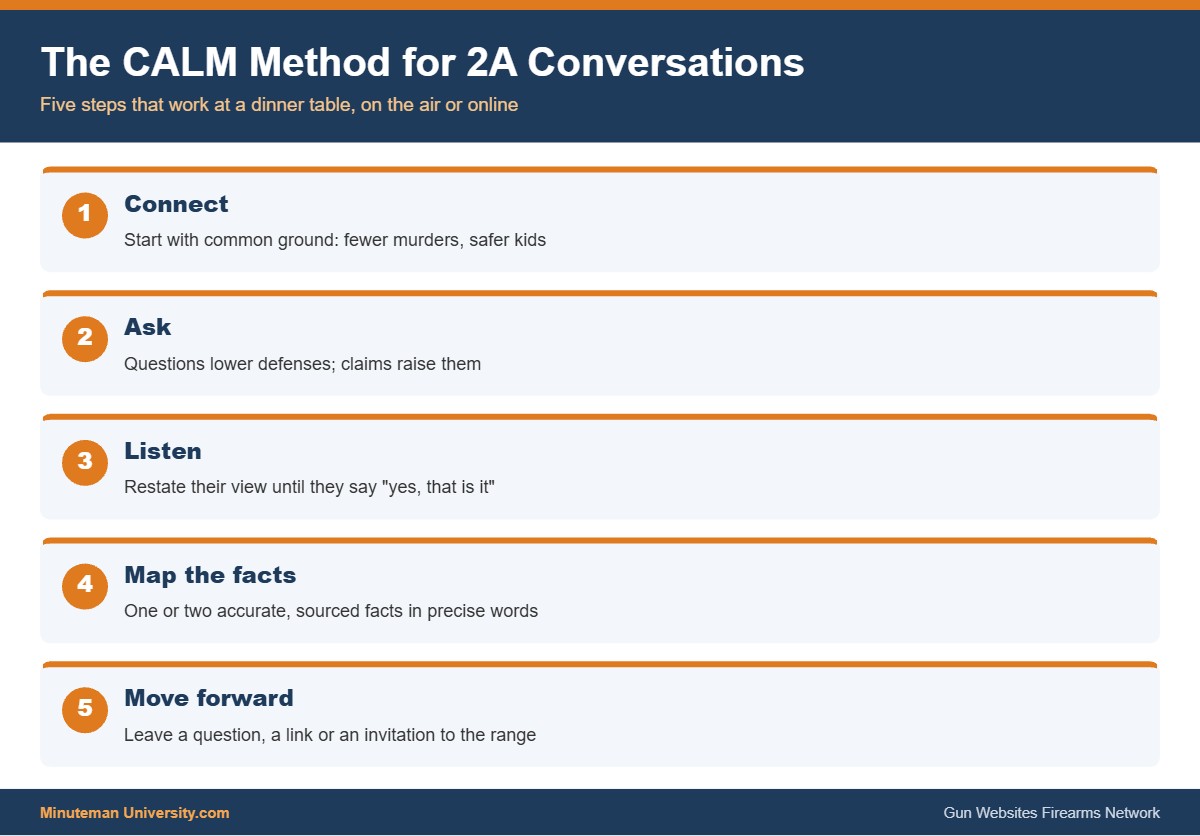
The CALM Method
Five steps that work at a dinner table, on a call-in show or in a comment thread.
Seek first to understand, then to be understood.
Stephen R. Covey, The 7 Habits of Highly Effective People
The Learning Path
Six stages, from the words you use to speaking in public.
Each stage builds on the one before it.
1. Foundations: Say It Accurately
Words Matter
Call a murderer a murderer. Sixteen word swaps that keep the focus on the criminal.
Guns in Language
Expressions, phrases and idioms that came from firearms, and why they matter.
Nomenclature
The correct names for parts and types of firearms. Accuracy earns credibility.
Jargon
Industry and legal terms decoded, so you can explain them in plain words.
Firearm Facts
Who regulates guns, who may buy them, and what the “gun show loophole” really is.
2. Techniques: Stay Calm and Persuasive
Verbal Judo
Redirect hostility with dignity and respect, using Dr. George Thompson’s method.
Street Epistemology
Ask how someone knows what they believe, instead of telling them they are wrong.
Communicating Without Pushing Buttons
Keep the temperature down when the topic runs hot.
Psychology of a Difficult Discussion
Why people dig in, and how to keep them from needing to.
Facts vs. Emotion
When numbers help, when stories help, and how to use both honestly.
Our Morals vs. Their Morals
Frame the case in values the listener already holds.
3. Know the Issues
Pro-Gun Arguments: Do’s and Don’ts
The arguments that persuade, the ones that backfire, and how to tell the difference.
Common Responses to Typical Positions
Calm answers to the claims heard most often.
How to Debate Gun Laws
Heller, McDonald, Bruen and Rahimi in plain English.
Large Capacity Magazines
Where the law stands and how to discuss “standard capacity” accurately.
Gun Debate Library
Fear of violence, correlation vs. causation and more research pages.
Strict vs. Intermediate Scrutiny
The legal tests courts use, explained simply.
Commerce Clause
How federal gun laws claim their authority.
Well-Researched Narrative
Build a story that holds up to fact-checking.
National Debate over Gun Control
The big picture of where the national conversation stands.
4. Know Your Audience
Generations of 2A
Values differ by generation. Speak to the person in front of you.
Knowing the Opposition
Understand the strongest version of the other side’s case.
Marginalize Gun Owners
Recognize the pattern and answer it without stooping to it.
2A Is ‘Woke’
Suicide prevention led by gun owners, not by new laws.
5. Practice
Conversation Trainer
Twelve real-world scenarios. Pick a reply, see why it works or fails, and get a score.
6. Go Public
LIVE 2A Conversations
Host a live show and bring guests into the conversation.
Creating Gun Content
Turn what you have learned into videos, posts and podcasts.
Systematize 2A
Make your outreach repeatable so it outlasts any one volunteer.
Levels of 2A Proficiency
See where you stand today and what the next level looks like.
What the Research Says
Persuasion is not guesswork. Researchers have tested what changes minds.
Facts still work
A 2019 review of studies with more than 10,000 people found that corrections usually move beliefs toward accuracy. The feared “backfire effect” is rare.
Explaining beats asserting
When people are asked to explain exactly how a policy would work, they often realize they know less than they thought, and their views soften.
Values beat volume
Arguments framed in the listener’s own moral values persuade better than arguments framed in the speaker’s values.
Listening changes minds
Conversations built on a respectful, non-judgmental exchange of personal stories have produced lasting changes in views in field experiments.
Quick Do’s and Don’ts
Say “murderer,” “criminal” and “lawful gun owner.”
Repeat the other side’s loaded terms, such as “gun violence,” without defining them.
Ask “What would that law change, exactly?”
Lead with a lecture or a statute number.
Cite one strong source the listener can check.
Bury people in twenty statistics at once.
Admit what you do not know and offer to look it up.
Bluff. One wrong fact can cost the whole conversation.
Invite a curious person to a safety class or the range.
Mock, insult or label anyone. Bystanders are watching.
- Using Technology and the Internet: social platforms, streaming, messaging, privacy and more
- Guns on Social Media: hashtags, reposting and staying on the right side of platform rules
- Internet Privacy: protect yourself before you speak up online
- 2A Maps: know where the laws stand, state by state, before the conversation starts
- Wood and Porter, “The Elusive Backfire Effect,” Political Behavior (2019)
- Fernbach, Rogers, Fox and Sloman, “Political Extremism Is Supported by an Illusion of Understanding,” Psychological Science (2013)
- Feinberg and Willer, “Moral Reframing: A Technique for Effective and Persuasive Communication,” Social and Personality Psychology Compass (2019)
- Kalla and Broockman, “Reducing Exclusionary Attitudes through Interpersonal Conversation,” American Political Science Review (2020)
- Stephen R. Covey, The 7 Habits of Highly Effective People (1989)