The gentle art of persuasion.
Use the other person’s energy.
Redirect it instead of meeting it head on.
Stay professional, whatever they say.
Verbal Judo is a method of calm, persuasive communication developed by Dr. George J. Thompson, a former English professor and police officer.
He began teaching it in the early 1980s and later wrote Verbal Judo: The Gentle Art of Persuasion (1993) with Jerry B. Jenkins.
It has been taught to hundreds of thousands of police officers, and it works just as well at a family dinner or in a comment thread.
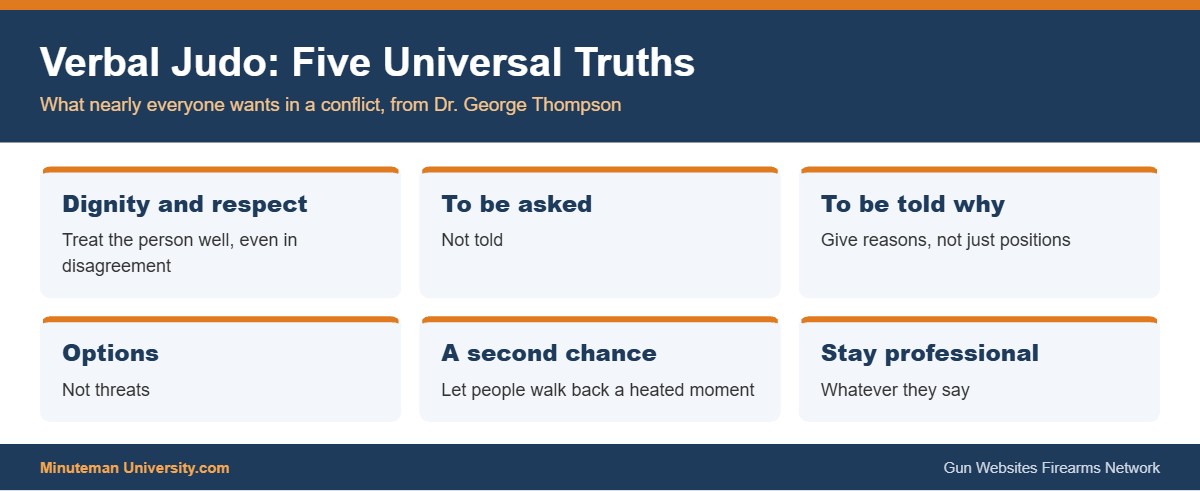
The Five Universal Truths
Thompson taught that nearly everyone, in any conflict, wants five things.
Dignity and respect
Treat the person well even when you reject their argument.
To be asked, not told
“Can I share how I see it?” lands better than “Here is the truth.”
To be told why
Explain the reason behind your position, not just the position.
Options, not threats
Offer choices: “We could look at the numbers, or I can send you the court case.”
A second chance
Let people walk back a heated comment without humiliation.
The Five-Step Approach
Deflectors: Let the Insult Pass
Thompson called them “strip phrases”: short replies that acknowledge an insult without taking the bait, then return to the point.
“I hear you, and I appreciate that you care about this. Here is what the law actually says.”
“Oh yeah? Well, you clearly do not know anything about guns.”
“That may be. Can I ask what you think the law would change?”
Matching their tone, volume or language.
Recognizing what triggers fear, inadequacy or shame in a conversation, in others and in yourself, is the first step to staying in control of your own reaction.
- 2A Conversation Skills – the full learning path and the CALM Method
- Conversation Trainer – practice with twelve real scenarios
- Words Matter – accurate language that keeps the focus on the criminal
- George J. Thompson and Jerry B. Jenkins, Verbal Judo: The Gentle Art of Persuasion (William Morrow, 1993; updated 2013)
- Verbal Judo Institute