The right name for a part or a firearm type is the fastest way to show you know the subject.
Nomenclature: Using Accurate Firearm Terms
Nomenclature is the standard set of names for the parts, types and functions of firearms. In everyday conversation, a loose term costs little. In a legislative hearing, a news interview or a courtroom, it can change the meaning of a law. Statutes regulate items by definition, so the difference between “semi-automatic” and “automatic,” or between a “magazine” and a “clip,” can decide what a bill actually covers and who it affects. Speaking precisely is one of the most effective tools a 2A advocate has, because it shows command of the subject and keeps the discussion on what a proposal would really do.
Accuracy works in both directions. Advocates gain nothing by correcting a reporter’s word choice in a way that sounds dismissive; the stronger approach is to state the correct term, explain the practical difference in one sentence, and move on to the policy question. It also helps to know which terms are legal definitions and which are political or marketing labels. “Machine gun,” “silencer” and “short-barreled rifle” are defined in federal statute. “Assault weapon” was defined in federal law from 1994 to 2004 and is still defined, differently, in several state laws. “Assault rifle,” “ghost gun” and “high-capacity magazine” are common in public debate, with meanings that vary by speaker or by state. Supporters of a given restriction usually prefer the broader label, while gun owners usually prefer the technical term; describing what the specific law actually covers avoids that argument.
This page lists the terms that cause the most confusion. For slang and specialized shooting vocabulary, see Jargon; for everyday expressions, see Guns in Language.
Key Facts
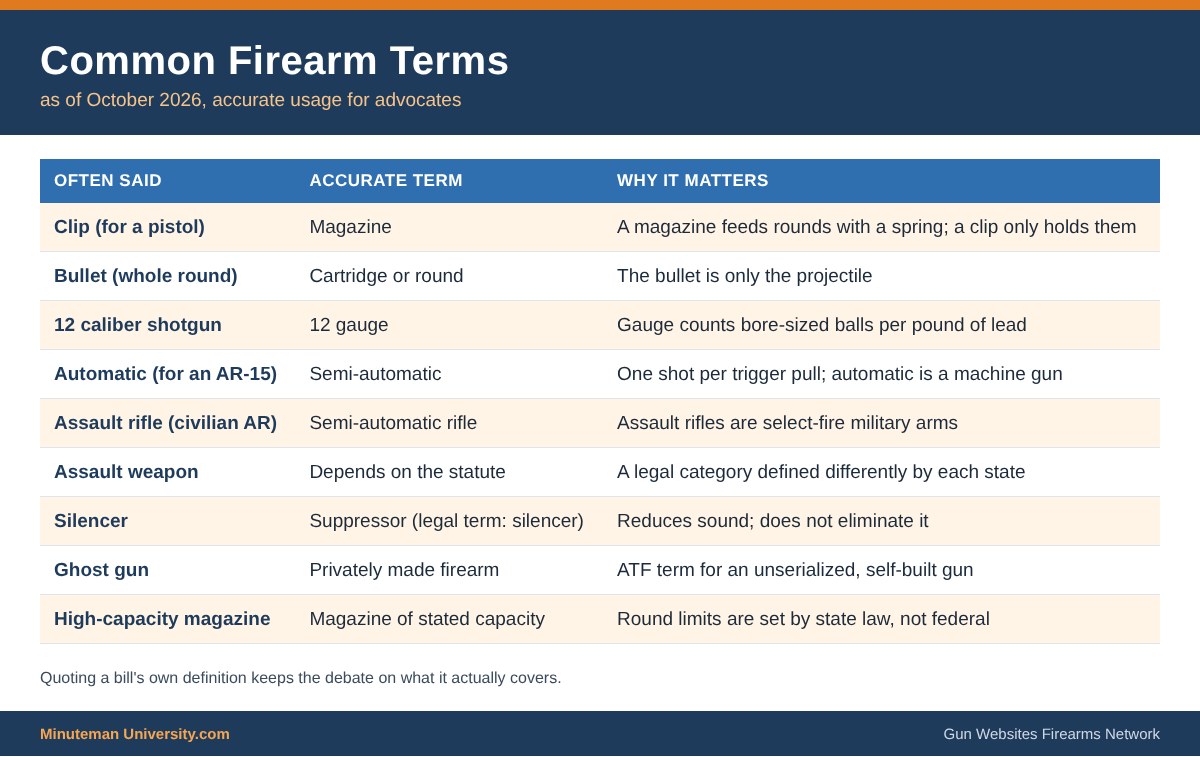
- Clip vs. magazine: A magazine holds cartridges and feeds them into the action with a spring. A clip holds cartridges for loading into a magazine (stripper clip) or is inserted with them (en bloc clip, as in the M1 Garand).
- Cartridge vs. bullet: A cartridge, or round, is the complete unit of case, primer, powder and bullet. The bullet is only the projectile.
- Caliber vs. gauge: Caliber is the approximate bore or bullet diameter (.308 inch, 9mm). Gauge measures shotgun bores by the number of bore-sized lead balls that weigh one pound, so a 12-gauge is larger than a 20-gauge. The .410 bore is the exception, named by its diameter.
- Semi-automatic vs. automatic: Semi-automatic fires one shot per trigger pull and reloads itself. Automatic fires continuously while the trigger is held; federal law calls this a “machinegun” (26 U.S.C. 5845(b)), and civilian transfers are limited to guns registered before May 19, 1986.
- Assault rifle vs. “assault weapon”: Militaries use “assault rifle” for select-fire rifles capable of automatic fire. “Assault weapon” is a legal category of semi-automatic firearms defined by features such as pistol grips or detachable magazines; the federal definition (18 U.S.C. 921(a)(30)) lapsed with the 1994 ban on September 13, 2004, and state definitions differ.
- Silencer vs. suppressor: Federal law uses “silencer” (18 U.S.C. 921(a)(25)); shooters and manufacturers generally say “suppressor,” since the device reduces rather than eliminates sound.
- “Ghost gun”: Not a federal statutory term. ATF’s 2022 rule, upheld in Bondi v. VanDerStok (March 26, 2025), uses “privately made firearm” for an unserialized gun built by an individual.
- “High-capacity” or “large-capacity” magazine: Defined only by state or local law, usually by a round limit such as more than 10 or more than 15, which often describes standard factory magazines.
What Gun Owners Should Know
- When testifying or commenting on a bill, quote the bill’s own definition and explain what common firearms it would actually include.
- Correct terms briefly and politely, then return to the substance. Tone persuades undecided listeners more than the correction itself.
- “Assault weapon” has no single meaning. Under a given state’s law it may cover common rifles, pistols and shotguns; check the exact statute on State Gun Bans.
- NFA terms such as SBR, SBS and AOW have precise legal definitions; see NFA Buyers Guide.com and Suppressor Buyers Guide.com.
- Magazine and clip types, with photos and history, are covered at Magazine Buyers Guide.net.
- Practice the vocabulary with quizzes at Tactical Quiz.com.
Related Pages
Across the Gun Websites Network
- Training Glossary After Action.net
- AR15 Glossary AR15 Buyers Guide.com
- Clips vs. Magazines Magazine Buyers Guide.net
Sources
- 18 U.S.C. 921, Definitions (Cornell LII)
- 26 U.S.C. 5845, NFA Definitions (Cornell LII)
- 27 CFR 478.11, Meaning of Terms (Cornell LII)
- SAAMI Glossary of Industry Terms