Firearm Facts: Quick Answers to the Questions Everyone Asks
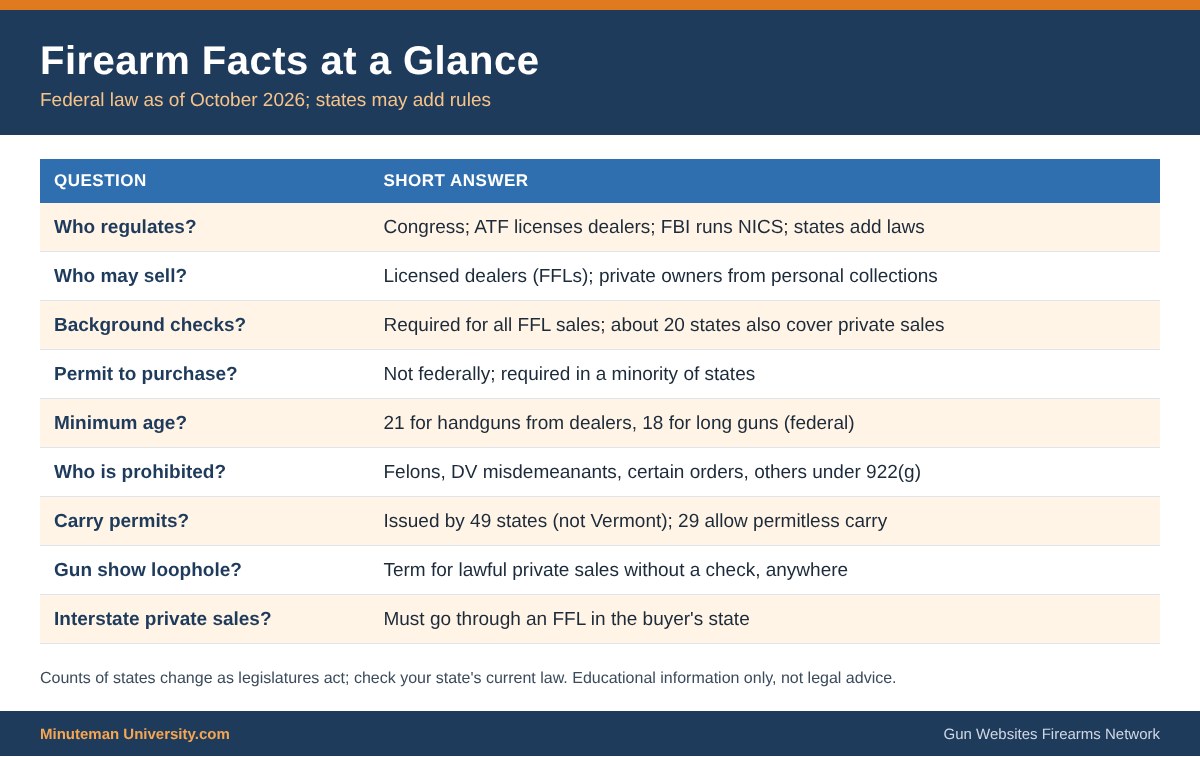
Gun debates often stall because people start from different assumptions about what current law already requires. This page gives short, factual answers to the most common questions, based on federal law as of 2026, with notes where state law commonly differs. The questions below are the outline; the graphic summarizes the answers at a glance.
Who regulates firearms? Congress writes federal law, the ATF (Bureau of Alcohol, Tobacco, Firearms and Explosives) licenses dealers and enforces it, and the FBI runs the National Instant Criminal Background Check System (NICS). States and, where state law allows, cities add their own rules. Who may sell? Anyone "engaged in the business" of dealing firearms must hold a Federal Firearms License (FFL). Private individuals may sell from their personal collections, but not across state lines without going through an FFL.
Background checks and permits. Every sale by an FFL requires a NICS check and a Form 4473. Federal law does not require checks on private sales between residents of the same state, but about 20 states require checks on some or all private sales, and a smaller number require a permit or license to purchase. Minimum age: federal law sets 21 for buying a handgun from a dealer and 18 for rifles and shotguns; federal appeals courts have split on whether the handgun limit is constitutional, and some states set 21 for all purchases. Who is prohibited? 18 U.S.C. 922(g) lists categories including felony convictions, misdemeanor domestic violence convictions, certain restraining orders, unlawful drug users, and people adjudicated mentally incompetent or committed.
Carry permits and the "gun show loophole." As of 2026, 29 states allow permitless (constitutional) carry for eligible adults, and every state except Vermont issues carry permits, which must be shall-issue after Bruen (2022). The phrase "gun show loophole" refers to lawful private sales without a background check; those sales follow the same rules at a gun show as anywhere else, while dealers at shows must run checks. Who supports more restrictions, and why? Advocacy groups such as Everytown, Brady and Giffords argue that measures like universal checks and red flag laws reduce deaths; gun-rights groups respond that such laws burden lawful owners and do little to stop criminals, citing a 2019 Bureau of Justice Statistics survey in which about 1 in 10 state and federal prisoners who had a gun during their offense said they bought it from a retail source.
Key Facts
- NICS is run by the FBI; dealers are licensed by the ATF.
- The Bipartisan Safer Communities Act (2022) added enhanced checks for buyers under 21.
- 29 states have permitless carry as of 2026; counts change as legislatures act.
What Gun Owners Should Know
- Selling privately? Confirm the buyer lives in your state and is not prohibited; many owners use an FFL transfer for peace of mind.
- State law can be stricter than federal law on age, checks, waiting periods and carry.
- Use accurate terms in debate: private sale, licensed dealer, NICS check.
Related: Background Checks, The 4473, 18 vs. 21 Age, Constitutional Carry, Gun Control Advocates, and reader questions on Ask Gun Questions.com.
Sources
- 18 U.S.C. 922: Unlawful Acts (Cornell LII)
- FBI: National Instant Criminal Background Check System
- ATF: Firearms
- BJS: Source and Use of Firearms Involved in Crimes (2019)
- Constitutional Carry (overview)
Firearm Facts