Last reviewed November 1, 2026
Castle Doctrine: Where It Stands in 2026
The Castle Doctrine is the oldest and most widely accepted self-defense principle in American law: no one is required to retreat from their own home before defending themselves and their family against a violent intruder. Every state recognizes some version of it, whether in statute, case law or both. Where states differ is in the details, such as whether protection extends to an occupied vehicle or workplace, and whether the law presumes the defender acted out of reasonable fear.
This map has friends. Lots of friends. Meet the State Gun Law Maps
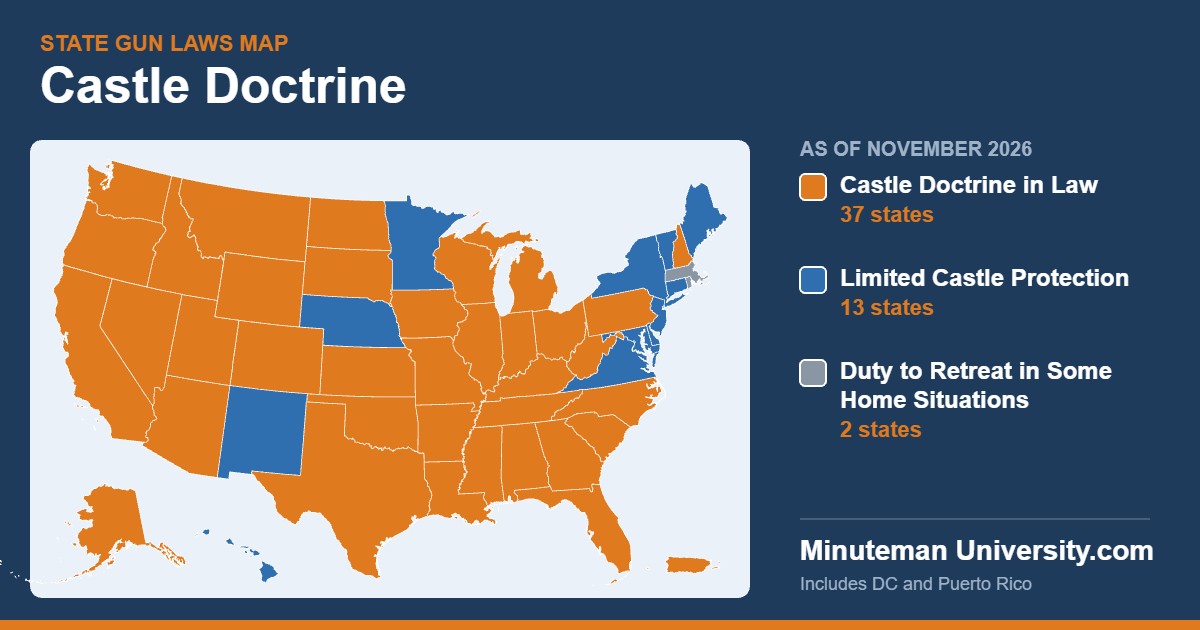
Castle Doctrine in Law (37): Alabama, Alaska, Arizona, Arkansas, California, Colorado, Florida, Georgia, Idaho, Illinois, Indiana, Iowa, Kansas, Kentucky, Louisiana, Michigan, Mississippi, Missouri, Montana, Nevada, New Hampshire, North Carolina, North Dakota, Ohio, Oklahoma, Oregon, Pennsylvania, Puerto Rico, South Carolina, South Dakota, Tennessee, Texas, Utah, Washington, West Virginia, Wisconsin, Wyoming
Limited Castle Protection (13): Connecticut, Delaware, District of Columbia, Hawaii, Maine, Maryland, Minnesota, Nebraska, New Jersey, New Mexico, New York, Vermont, Virginia
Duty to Retreat in Some Home Situations (2): Massachusetts, Rhode Island
How this map is researched, from statute to state note: How We Research.
Many states have strengthened the doctrine with a statutory presumption. Under Florida’s model (Fla. Stat. 776.013), a person is presumed to have held a reasonable fear of death or great bodily harm when an intruder unlawfully and forcibly enters an occupied dwelling, residence or vehicle. Colorado’s 1985 “Make My Day” law (C.R.S. 18-1-704.5) grants immunity to occupants who use force against an intruder they reasonably believe intends to commit a crime and may use physical force. These presumptions shift the focus to the criminal who broke in, not the homeowner who answered the threat.
The home is also protected against the government. In Caniglia v. Strom (2021), a unanimous Supreme Court rejected a “community caretaking” exception that police had used to enter a home without a warrant and seize the owner’s handguns. In January 2026, Case v. Montana confirmed that warrantless home entry is allowed under the emergency-aid exception only when officers have an objectively reasonable basis to believe someone inside needs immediate help, and only to the extent the emergency requires.
Key Facts
- All 50 states recognize Castle Doctrine protection in the home in some form, although the scope (vehicles, businesses, curtilage) varies by state.
- 1985: Colorado enacted its “Make My Day” home-defense immunity statute, C.R.S. 18-1-704.5.
- 2005: Florida added a statutory presumption of reasonable fear for forcible entry into an occupied home or vehicle (Fla. Stat. 776.013), a model later copied by other states.
- May 17, 2021: Caniglia v. Strom, 593 U.S. 194 (9-0), held that the “community caretaking” exception does not justify warrantless entry and gun seizure in the home.
- January 14, 2026: Case v. Montana (9-0) applied the Brigham City “objectively reasonable basis” standard to emergency-aid home entries, rejecting a probable-cause requirement but limiting the scope of any search.
What Gun Owners Should Know
- The Castle Doctrine protects against unlawful, forcible entry. It generally does not cover force against invited guests, people with a legal right to be in the home, or police acting lawfully.
- Check whether your state extends protection to your vehicle, business or yard; many states stop at the dwelling itself.
- Have a home-defense plan, secure storage that still allows quick access, and know where family members will be. See After Action.net for training resources.
- After any defensive incident, call 911, cooperate with officers on scene safety, and speak with an attorney before giving a detailed statement.
- Outside the home, the rules depend on your state’s Stand Your Ground law. Consider the legal-defense options on the CCW Insurance page.
Sources
- NCSL: Self-Defense and Stand Your Ground
- Florida Statutes Chapter 776: Justifiable Use of Force
- Caniglia v. Strom, 593 U.S. 194 (2021)
- Case v. Montana, No. 24-624 (2026), Supreme Court opinion
Background and Resources
Castle Doctrine is the right to defend your home or “castle” through the use of reasonable or even deadly force
permits defending against an intruder who uses force to unlawfully enter or attempt to enter the occupied home, vehicle, or place of business
or
to use force against an intruder who attempts to unlawfully and forcibly remove a person from the person’s home, vehicle, or business
- Originated in England
– “a man’s house is his castle”
Fourth Amendment
- protects people, their homes, and their property
- against unreasonable searches and seizures by the government
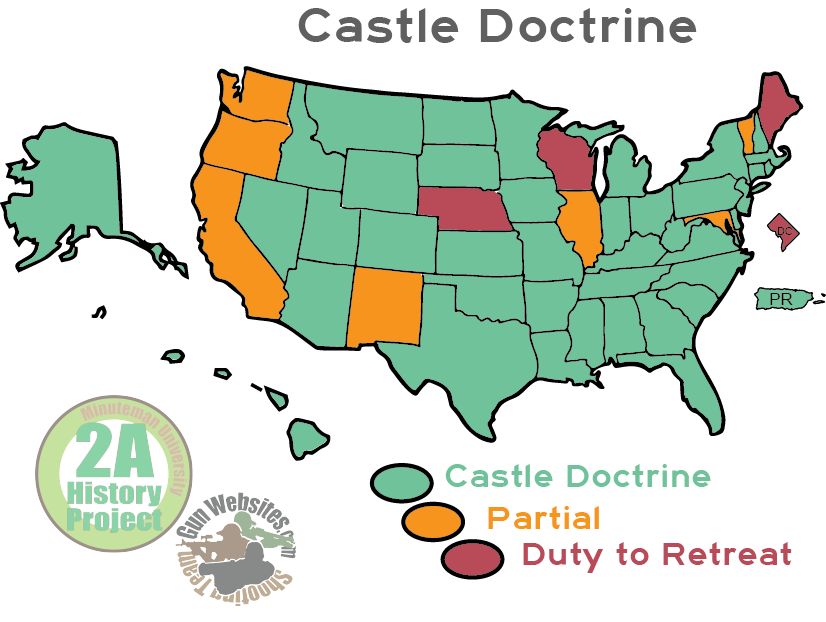 A 2021 original from the human era. Every state on it was defended by hand, no robots allowed inside the castle.
Castle Doctrine implies the right to Stand Your Ground
- Does not require a duty to retreat