Gun Shows: How They Work and What the Law Requires
Gun shows are a long-standing part of American firearms culture. Held in convention centers, fairgrounds and community halls, they bring together licensed dealers, private collectors, ammunition and accessory vendors, knife makers, militaria sellers, gun clubs and advocacy groups under one roof, usually for a weekend. For many owners they are the best place to handle a wide range of firearms in person, find collectible and historical pieces, compare prices and meet others in the community. Show dates across the country are listed at Gun Calendars.com.
Federal law treats sales at a gun show the same way it treats sales anywhere else. A federally licensed dealer (FFL) at a show must have the buyer complete ATF Form 4473 and run a background check through NICS, exactly as in a store, and ATF regulations (27 CFR 478.100) allow licensees to conduct business at qualifying gun shows in the state where their licensed premises is located. A private individual who is not “engaged in the business” of dealing in firearms may sell from a personal collection without a license, and federal law does not require a background check on that sale, although it remains illegal to sell to anyone the seller knows or has reasonable cause to believe is prohibited or lives in another state.
That distinction is the center of the “gun show loophole” debate. Supporters of universal background checks argue that private sales at shows and elsewhere let buyers avoid a check in states that do not require one, and they favor requiring all transfers to go through a licensed dealer. Opponents argue the term is misleading because there is no special exemption for gun shows, dealers at shows run the same checks as anywhere else, and federal survey data show very few criminals obtain guns at shows; a 2019 Bureau of Justice Statistics report found 0.8 percent of state and federal prisoners who had a firearm during their offense obtained it at a gun show.
The definition of who is “engaged in the business” has been contested in recent years. The Bipartisan Safer Communities Act (June 25, 2022) broadened it to anyone who deals to “predominantly earn a profit.” A 2024 ATF rule built on that change, but a federal court in Texas v. ATF vacated the rule on June 12, 2026, and in May 2026 ATF proposed rescinding key parts of it. The statutory definition from 2022 remains in effect.
Key Facts
- Dealers at shows: FFLs must run NICS checks and complete Form 4473 for every sale, whether at a store or a show.
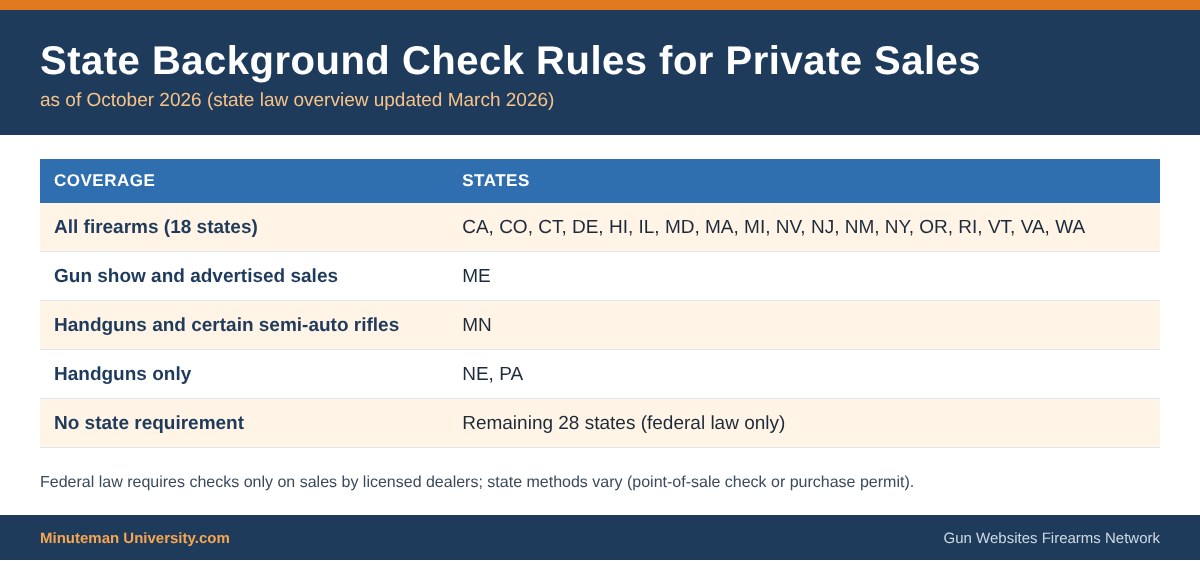
- Private sales: federal law does not require a background check for a sale by a private, unlicensed seller to a resident of the same state, but 22 states require checks or purchase permits for some or all private sales (see table).
- Out-of-state buyers: private sellers may not sell directly to residents of other states; interstate transfers must go through an FFL.
- June 25, 2022: the Bipartisan Safer Communities Act redefined “engaged in the business” to cover those who deal to “predominantly earn a profit.”
- June 12, 2026: the U.S. District Court for the Northern District of Texas vacated ATF’s 2024 “engaged in the business” rule in its entirety; a motion to narrow the judgment was denied August 13, 2026.
- May 6, 2026: ATF published a proposed rule to rescind provisions of the 2024 rule; the comment period closed August 4, 2026.
- BJS (January 2019): 0.8 percent of prisoners who possessed a firearm during their offense got it at a gun show; more than half obtained it through theft, the street or underground market, or found it at the scene.
What Gun Owners Should Know
- Know your state. If your state requires private sales to go through a dealer or a permit, that applies at shows too. Many shows have an on-site FFL who can process private transfers for a fee.
- Selling from your collection: occasional sales to improve or liquidate a personal collection do not require a license, but repeated buying and reselling for profit can. When unsure, use an FFL.
- Protect yourself as a private seller: ask for a state ID to confirm residency, consider a bill of sale, and never sell if anything suggests the buyer is prohibited or buying for someone else. Straw purchasing is a federal crime.
- Bringing a firearm to a show: most shows require firearms to be unloaded, checked at the door and secured with a zip tie. Check the promoter’s rules and local carry laws in advance.
- Inspect before you buy. Check bore, action, serial number and condition, and verify any NFA paperwork. Related resources: NFA Buyers Guide.com, Magazine Buyers Guide.net and Gun Websites.com.
- Learn more: see Background Checks, State Firearm Laws and Firearm Auctions.
Across the Gun Websites Network
- Gun Show Laws Gun Show Reviews.com
- Major Gun Shows in the USA Gun Show Reviews.com
- Gun Show Calendar Gun Show Reviews.com
Sources
- Source and Use of Firearms Involved in Crimes: Survey of Prison Inmates, 2016 (Bureau of Justice Statistics, 2019)
- Definition of “Engaged in the Business” as a Dealer in Firearms (ATF)
- 27 CFR 478.100, Conduct of Business Away from Licensed Premises (eCFR)
- Background Checks on All Gun Sales, State Law Overview (Everytown Research)