Last reviewed October 31, 2026
Primitive Weapons: Where It Stands in 2026
“Primitive weapons” usually means muzzleloading firearms (flintlock, percussion and in-line black powder guns) and, in hunting regulations, traditional archery. They connect today’s gun owners directly to the arms of the founding generation, the same type of firearms carried at Lexington and Concord.
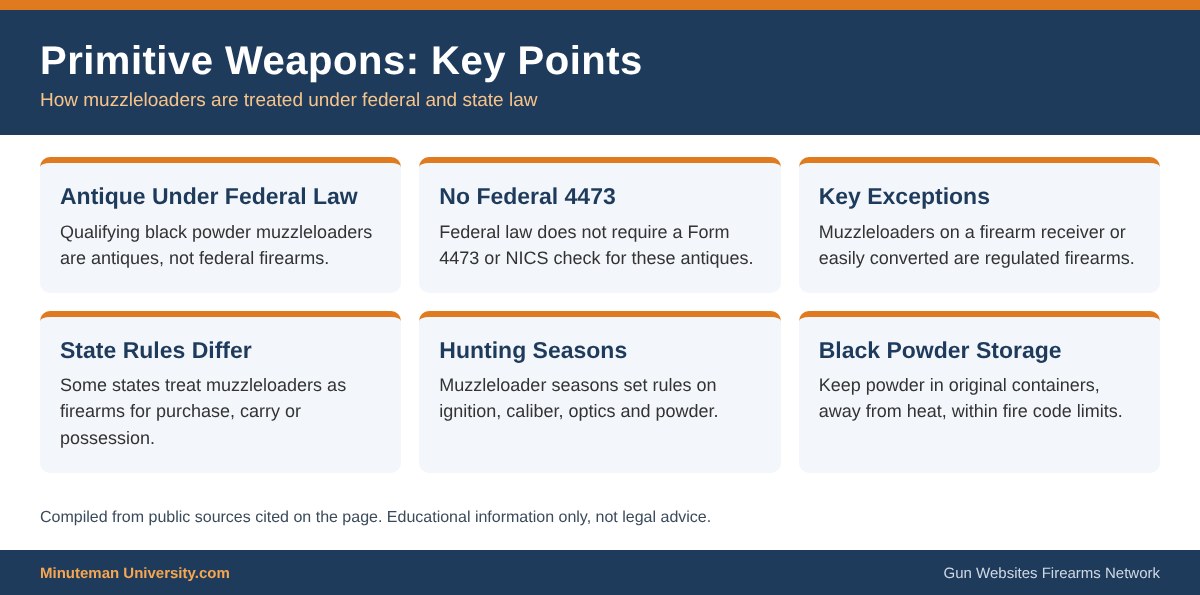
Under federal law, most muzzleloaders are not “firearms” at all. The Gun Control Act’s definition of “antique firearm” (18 U.S.C. 921(a)(16)) includes any muzzle-loading rifle, shotgun or pistol designed to use black powder or a substitute that cannot use fixed ammunition. A dealer sale of such a gun does not require a Form 4473 or NICS check under federal law, and it can generally be shipped directly to a buyer. The exception matters: a muzzleloader built on a firearm frame or receiver, or one that can be readily converted to fire fixed ammunition by swapping the barrel, bolt or breechblock, is a regulated firearm.
States set their own rules. Many states treat muzzleloaders like any other firearm for certain purposes, such as possession by prohibited persons, carry and hunting, and most states hold special muzzleloader or primitive weapons seasons with their own equipment rules on ignition type, caliber, scopes and powder. Recent state restrictions often exempt antiques; Virginia’s 2026 ban on sales of many semi-automatic firearms, for example, exempts antique firearms.
Key Facts
- 18 U.S.C. 921(a)(16)(C): qualifying black powder muzzleloaders are “antique firearms,” excluded from the federal definition of firearm.
- Exclusion does not apply to muzzleloaders that use a firearm frame or receiver or are readily convertible to fixed ammunition.
- Black powder in quantities for sporting use is governed by federal explosives rules (27 CFR Part 555), with exemptions for limited personal amounts; substitutes such as Pyrodex are treated differently.
- Virginia SB 749 (signed May 14, 2026, effective July 1, 2026) exempts antique firearms from its sales ban.
What Gun Owners Should Know
- Check your state’s definition: a muzzleloader that is exempt federally may still count as a firearm under state law for purchase, carry or prohibited-person rules.
- Read your state wildlife agency’s muzzleloader season rules every year; legal ignition systems, projectiles and optics change.
- Store black powder in original containers, away from heat, and follow local fire codes for quantity limits.
- Learn more on related pages: Antique Firearms and Gun Permits. Firearms history and anniversaries are on Gun Calendars.com.