Last reviewed October 31, 2026
Short Barrel Rifles: Where It Stands in 2026
A short barrel rifle (SBR) is a rifle with a barrel under 16 inches or an overall length under 26 inches, or a weapon made from a rifle that ends up under those limits. Since 1934 the National Firearms Act has treated SBRs like machine guns on paper: a $200 tax, federal registration and months of waiting for ATF approval. Gun-rights advocates have long argued there is no sound reason a rifle with a 14.5-inch barrel should be regulated more heavily than a handgun.
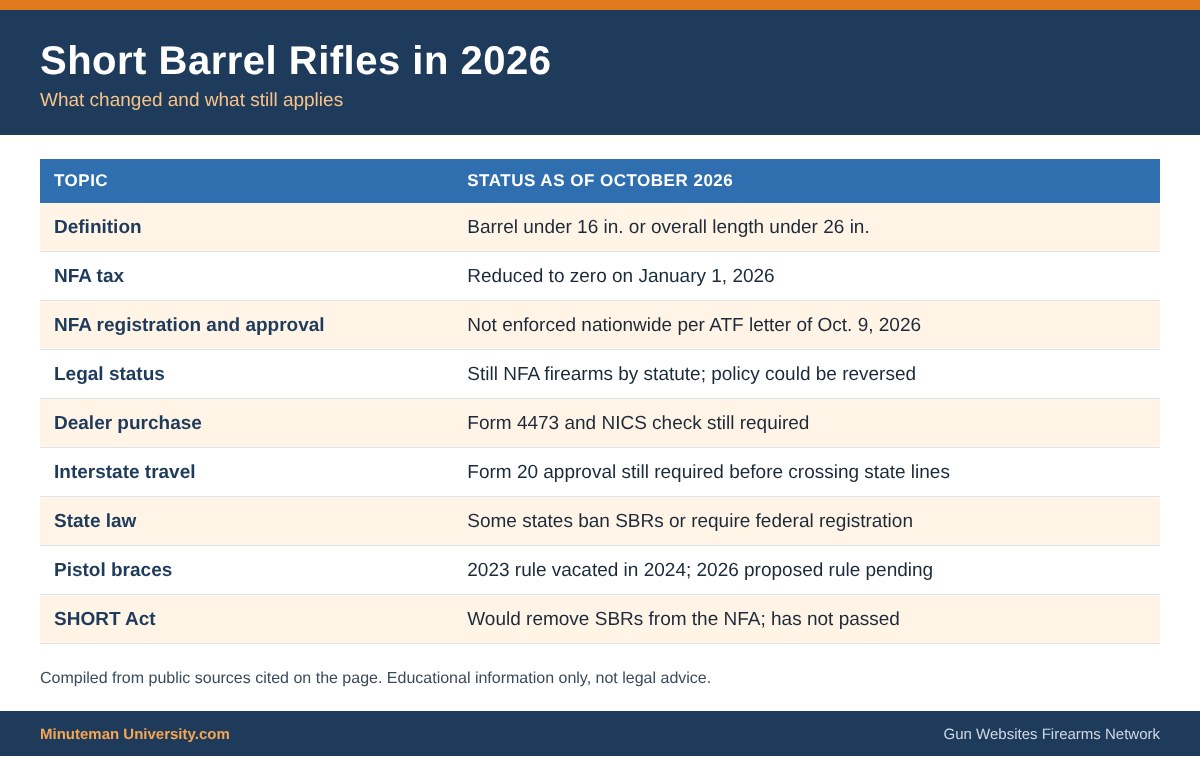
2026 changed the picture. The One Big Beautiful Bill Act (signed July 4, 2025) cut the NFA tax on SBRs to $0 effective January 1, 2026. After the August 5, 2026 judgment in Silencer Shop Foundation v. ATF / Jensen v. ATF (N.D. Tex.) and DOJ’s decision not to appeal, ATF announced on October 9, 2026 that it would no longer enforce NFA approval, registration or tax-stamp requirements for SBRs nationwide.
Important limits remain. SBRs are still NFA firearms by statute, and ATF says the non-enforcement policy could be reversed. Dealers still run a Form 4473 and NICS check. ATF still requires approval on Form 20 before an SBR is moved across state lines. Several states ban or restrict SBRs under their own laws. The SHORT Act (H.R. 2395 / S. 1162), which would remove SBRs and SBSs from the NFA permanently, has not passed.
On pistol braces, the 2023 ATF brace rule was vacated by the Northern District of Texas in Mock v. Garland in June 2024. On May 6, 2026, ATF published a proposed rule to remove the brace “factoring criteria” from the regulatory definition of rifle entirely; the comment period ran through August 4, 2026.
Key Facts
- Definition: Rifle with barrel under 16 inches or overall length under 26 inches (26 U.S.C. 5845(c); 18 U.S.C. 921).
- January 1, 2026: NFA making and transfer tax on SBRs reduced from $200 to $0.
- August 5, 2026: Final judgment in Silencer Shop Foundation v. ATF (Judge James Wesley Hendrix, N.D. Tex.).
- October 9, 2026: ATF open letter: nationwide non-enforcement of NFA registration and approval for SBRs, SBSs, suppressors and AOWs.
- Still required: Form 4473 and NICS at a dealer; ATF Form 20 approval before interstate transport (18 U.S.C. 922(a)(4)).
- May 6, 2026: ATF proposed rule RIN 1140-AA98, “Removing Factoring Criteria for Firearms with Attached Stabilizing Braces”; comments closed August 4, 2026.
What Gun Owners Should Know
- Check state law before building or buying. Some states ban SBRs outright, and some require federal registration to be lawful under state law.
- If you travel with an SBR, file Form 20 and wait for approval before crossing state lines. That requirement was not lifted.
- If you want your SBR registered, ask your dealer to file the Form 4 at the time of transfer; ATF generally does not register items after the fact.
- Keep all paperwork, including older approved Form 1s and Form 4s. They remain valid proof of lawful status.
- Braced pistols are on firmer ground than at any time since 2023, but watch for the final brace rule before relying on any change.
- More coverage: NFA Buyers Guide.com, the National Firearms Act (NFA) overview, Short Barrel Shotguns and Court Cases.
Across the Gun Websites Network
- Short-Barreled Rifles and Shotguns NFA Buyers Guide.com
- Short Barreled AR15s AR15 Buyers Guide.com
Sources
- American Rifleman: ATF Ends Enforcement of NFA Registration and Approval Requirements (Oct. 9, 2026)
- ATF: Removing Factoring Criteria for Firearms with Attached Stabilizing Braces (RIN 1140-AA98)
- 26 U.S.C. 5845: NFA Definitions (Cornell LII)
- Silencer Shop: What the Silencer Shop Foundation v. ATF Win Means for You