Last reviewed October 31, 2026
Military 2A Issues: Where It Stands in 2026
Service members swear an oath to defend the Constitution, yet they face some of the most confusing firearm rules of any Americans. Frequent moves under Permanent Change of Station (PCS) orders mean crossing state lines with personal firearms, buying in a new state and living on installations that historically barred personal carry.
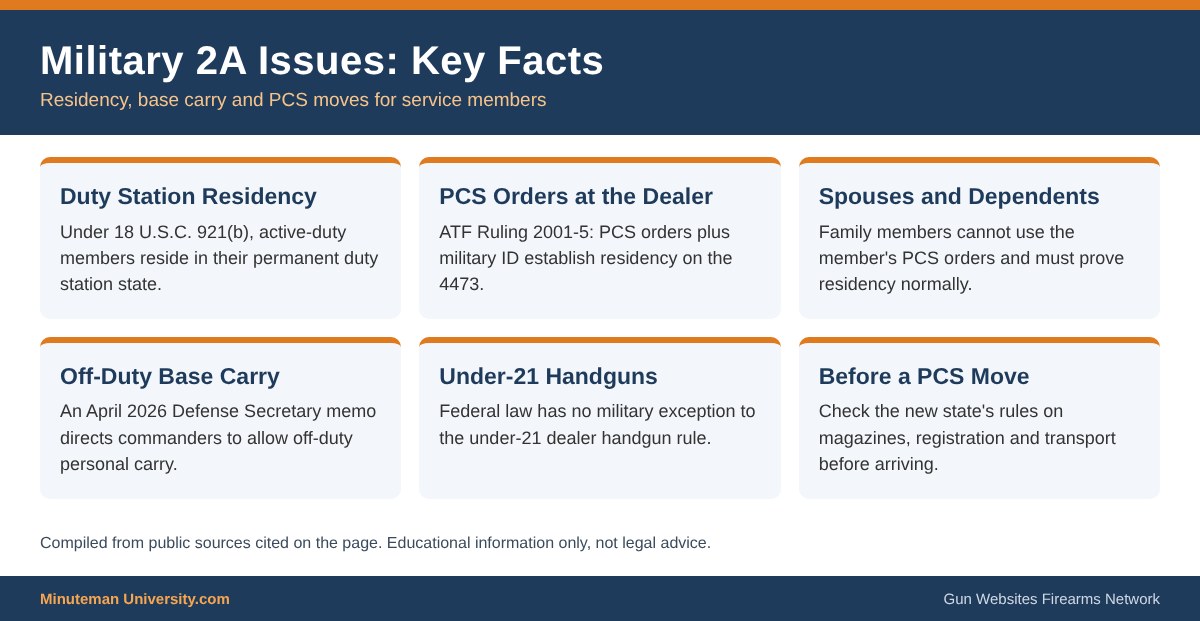
For purchases, federal law treats an active-duty member as a resident of the state where his or her permanent duty station is located (18 U.S.C. 921(b)). Dealers can accept PCS orders, including electronic orders, together with a military ID to establish residency (ATF Ruling 2001-5). That rule does not cover spouses and dependents, who must prove residency the usual way. Legislation introduced by Sen. Mike Rounds in the 119th Congress, the Protect Our Military Families’ 2nd Amendment Rights Act, would extend 921(b) residency to military spouses; it has not become law.
On base, the big change came in April 2026, when Secretary of Defense Pete Hegseth signed a memo directing installation commanders to allow off-duty service members to carry privately owned firearms for personal protection, with a presumption that such carry is necessary. Supporters cited past attacks on installations where troops could not defend themselves. Implementation runs through each installation, so local rules and registration procedures still matter. Young troops should also note the age question: federal law has no military exception to the under-21 dealer handgun ban, though some states, such as Virginia, carve out military members in their own age laws.
Key Facts
- 18 U.S.C. 921(b): an active-duty member is a resident of the state of his or her permanent duty station.
- ATF Ruling 2001-5: PCS orders (paper or electronic) plus a valid military ID establish residency on the Form 4473.
- Spouses and dependents cannot use the member’s PCS orders for residency, per ATF.
- April 2026: Defense Secretary Hegseth memo directing commanders to allow off-duty carry of personal firearms on installations.
- September 18, 2026: DOJ opinion says the federal under-21 dealer handgun ban cannot be criminally enforced against sales to law-abiding adults 18 to 20; ATF guidance had not followed as of this update.
What Gun Owners Should Know
- Before a PCS move, check the gaining state’s laws on magazines, “assault weapons,” registration and transport; some states require registration soon after arrival.
- Register personal firearms with the installation as your base requires, and follow its storage rules for barracks and housing.
- Carry copies of PCS orders when buying from a dealer in your new duty state.
- Transport firearms unloaded and locked under the federal safe-passage law (18 U.S.C. 926A) when driving through restrictive states.
- Related pages: 18 yr vs. 21 yr Age, the 4473 and Gun Registration. Veterans and instructors can find training at After Action.net.
Sources
- ATF: What Documentation Does an Active-Duty Service Member Need?
- 18 U.S.C. 921 (Cornell LII)
- Washington Examiner: Hegseth Order Allows Troops to Carry Personal Firearms on Bases
- Sen. Rounds: Protect Our Military Families’ 2nd Amendment Rights Act (bill text)
Background and Resources
- PCS Orders