Truckers & Guns: Where It Stands in 2026
Professional drivers spend long hours alone, often parked overnight at truck stops, rest areas and shipper lots, and many want the ability to protect themselves. A common myth is that federal trucking rules ban drivers from carrying a firearm. They do not. The Federal Motor Carrier Safety Regulations do not address whether a driver may carry a firearm in a commercial motor vehicle. The real limits come from three other places: state carry laws, the federal rules for transporting firearms across state lines, and employer policy.
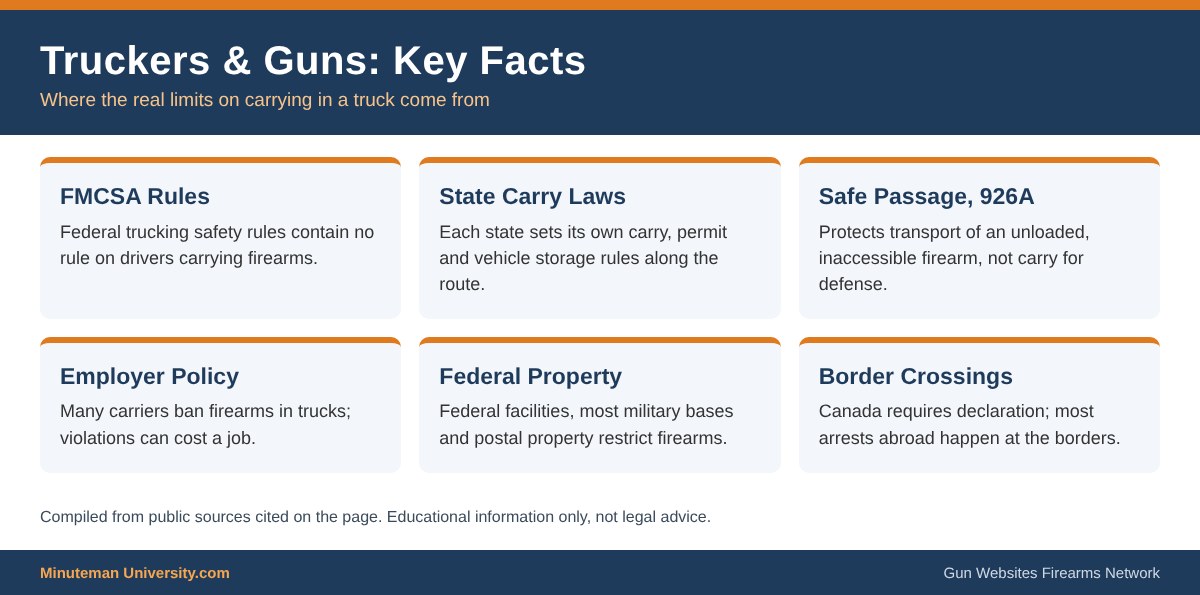
State law is the hardest part for an interstate driver. A truck can cross several states in a day, and each state sets its own rules on carrying in a vehicle, whether it honors out-of-state permits and what counts as “loaded” or “accessible.” Several states, including New York, New Jersey, California, Massachusetts, Maryland and Hawaii, generally do not honor other states’ carry permits, and violations there can carry felony penalties.
Federal law offers a safe-passage protection, 18 U.S.C. 926A, for people transporting firearms through restrictive jurisdictions. It applies only if the person may lawfully possess the firearm at the starting point and destination, the firearm is unloaded, and neither the firearm nor ammunition is readily accessible from the passenger compartment. In a vehicle without a separate trunk, that means a locked container other than the glove box or console. That requirement is difficult to meet in a sleeper-cab truck, and 926A protects transport, not carry for self-defense.
Employer policy is the third factor. Many motor carriers prohibit firearms in company trucks, and drivers who violate those policies risk termination even where carrying is legal. Owner-operators and drivers for carriers that allow firearms have more flexibility, but still must comply with state law on every mile of the route.
Key Facts
- FMCSA: the Federal Motor Carrier Safety Regulations contain no rule on drivers carrying firearms in commercial vehicles.
- 18 U.S.C. 926A (enacted in the Firearm Owners Protection Act of 1986): protects interstate transport of an unloaded, inaccessible firearm between places where the traveler may lawfully possess it.
- Employer rules: carriers may set their own firearms policies; violations can cost a job even where no law is broken.
- Federal property: firearms are restricted in federal facilities (18 U.S.C. 930), on most military installations, and on U.S. Postal Service property, which drivers delivering to those locations must plan for.
- Canada: all firearms must be declared at the border. Non-residents without a Canadian licence use a Non-Resident Firearm Declaration (Form RCMP 5589, CAN$25, valid up to 60 days). Personal protection is not an accepted purpose, prohibited firearms cannot be imported under any circumstances, and restricted firearms need an Authorization to Transport. Undeclared firearms can be seized and lead to criminal charges.
- Mexico: the U.S. State Department warns that most arrests of Americans for carrying firearms or ammunition abroad happen at the Canadian and Mexican borders, with penalties that can include large fines, vehicle confiscation, imprisonment and a lifetime ban.
What Gun Owners Should Know
- Read your company policy first. Get it in writing. If firearms are prohibited, carrying is a job decision as well as a legal one.
- Plan your route state by state. Check carry and vehicle-storage laws for every state you will enter, including whether your permit is honored. Start with State Firearm Laws.
- Know when you must switch to transport mode. Before entering a state that does not honor your permit, unload and lock the firearm and ammunition in a container not readily accessible, consistent with 926A, and do not stop there longer than necessary.
- Never cross an international border armed by accident. Before any run near Canada or Mexico, search the cab and sleeper for firearms and loose ammunition. Leaving a firearm behind before a cross-border load is the safest course.
- Watch for prohibited destinations. Federal facilities, military bases, ports with secure areas and some shipper or receiver properties ban firearms. Know before you arrive.
- Get trained. Defensive training should include vehicle-specific skills and legal use-of-force standards. See After Action.net.
- Ask specific questions at Ask Gun Questions.com and review Gun Free Zones.