School Teachers & Guns: Where It Stands in 2026
Whether teachers and other school employees should be allowed to carry firearms on campus is one of the most debated questions in school safety. It is decided almost entirely at the state level, and then often district by district. As of 2026, a majority of states have some legal path for authorized school staff to be armed, but the details differ enormously: some states run formal programs with set training hours and psychological screening, others leave the decision to school boards, and a few allow concealed carry permit holders on public school grounds.
Federal law sets the baseline. The Gun-Free School Zones Act (18 U.S.C. 922(q)) generally bars possessing a firearm in a school zone, but it exempts individuals licensed by the state in which the school is located and people acting under a contract with the school. That is why state laws and permits, not federal law, determine whether a given teacher may lawfully carry.
Texas was an early adopter. The Guardian Plan, which began in 2007 in the small Harrold Independent School District, lets local boards authorize licensed staff to carry under district-set training standards. In 2013 the Legislature created the School Marshal program (HB 1009), which requires an 80-hour course certified by the Texas Commission on Law Enforcement. Florida created its Guardian program in 2018 after the Parkland shooting and expanded it to classroom teachers in 2019; armed teacher training there requires at least 144 hours. Ohio’s House Bill 99, signed June 13, 2022, left the choice to local school boards and capped required initial training at 24 hours, and Tennessee’s 2024 law requires 40 hours of school policing training, a psychological evaluation and approval from the principal, the director of schools and local law enforcement.
Supporters argue that armed, trained staff can respond in the minutes before police arrive, which matters most in rural districts with long response times, and that the possibility of armed resistance may deter attackers. Opponents, including national teachers’ unions such as the NEA and AFT, argue that more guns in schools raise the risk of accidents, theft or misidentification by responding officers, and that the money is better spent on school resource officers, mental health services or physical security. Both sides agree that training, screening and coordination with law enforcement are the deciding factors in how any program performs.
Key Facts
- Federal law: 18 U.S.C. 922(q) exempts persons licensed by the state where the school is located, so state law controls.
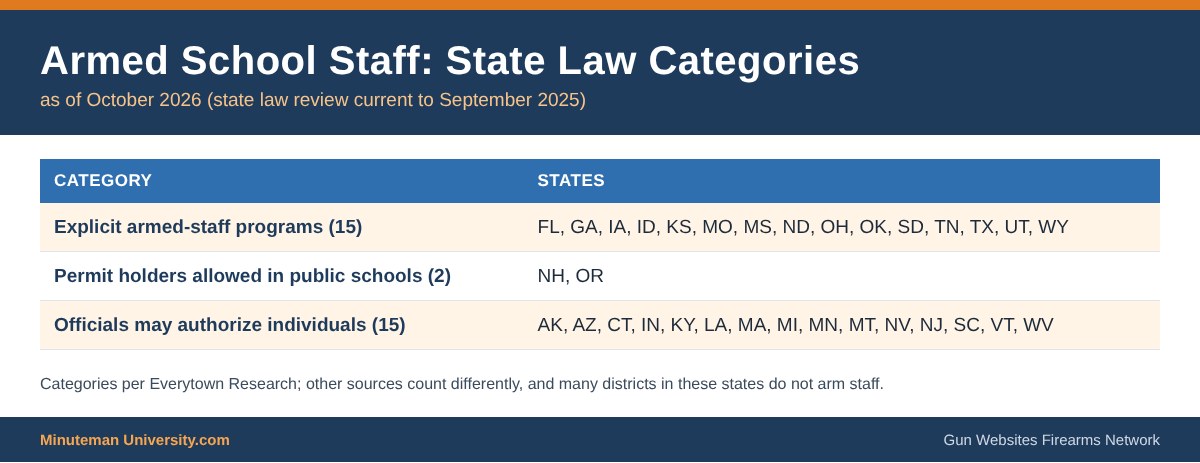
- Counts vary by source: news and policy reviews report roughly 30 or more states with some legal path for armed staff. An Everytown Research review (state map current as of September 2025) found 15 states with explicit armed-staff programs, 2 that allow permit holders in public schools, and 15 more that let school officials authorize specific individuals.
- Texas: Guardian Plan (since 2007, district-set training) and School Marshal program (HB 1009, 2013; 80-hour TCOLE course, License to Carry and psychological exam required).
- Florida: Guardian program created in 2018 and expanded to classroom teachers in 2019; minimum 144 hours of training.
- Ohio: HB 99, signed June 13, 2022, lets local school boards decide whether to arm staff and caps required initial training at 24 hours.
- Tennessee: 2024 law signed by Gov. Bill Lee requires a handgun carry permit, TBI background check, psychological certification, 40 hours of training and three-way approval.
- Local choice: in most programs, participation is voluntary for staff and optional for districts, and many districts in permissive states have chosen not to participate.
What Gun Owners Should Know
- A carry permit alone is usually not enough. In most states, carrying in a K-12 school requires specific authorization from the district or a state program. Carrying without it can be a serious crime even for a permit holder. See Gun Free Zones.
- Parents and visitors are treated differently from staff. Armed staff programs generally do not authorize parents picking up children to carry. Check state law on firearms locked in vehicles in school parking lots.
- Expect confidentiality. Many programs keep the identities of armed staff confidential; teachers interested in serving should ask their district how a program is structured.
- Training is the core issue. Staff considering a role should look at the hours, live-fire standards, scenario training and medical training required, and seek more on their own. Instructor and training resources are at After Action.net.
- Insurance and liability matter. District insurers and state immunity laws vary; staff should understand who is liable before carrying.
- Follow your state. Laws change most years. Check State Firearm Laws and track legislative sessions and 2A events at Gun Calendars.com.
Sources
- School Marshals (Texas Commission on Law Enforcement)
- Ohio Gov. DeWine Signs a Bill Arming Teachers After 24 Hours of Training (NPR, June 13, 2022)
- Tennessee Bill to Let Teachers Carry Guns in Schools (NBC News, April 2024)
- Unpacking Arming Teachers Laws (Everytown Research, 2025)
- 18 U.S.C. 922 (Cornell Legal Information Institute)