Center for Disease Control: Firearm Research, the Dickey Amendment and the Data
The Centers for Disease Control and Prevention (CDC) is the federal public health agency most often cited in the gun debate. Its role is twofold: it publishes the official national count of firearm deaths from death certificates, and through its National Center for Injury Prevention and Control it funds and conducts research on firearm injuries. Both roles matter to gun owners, because CDC numbers are quoted in legislatures, courtrooms and the press, and because the agency’s research priorities have been contested for three decades.
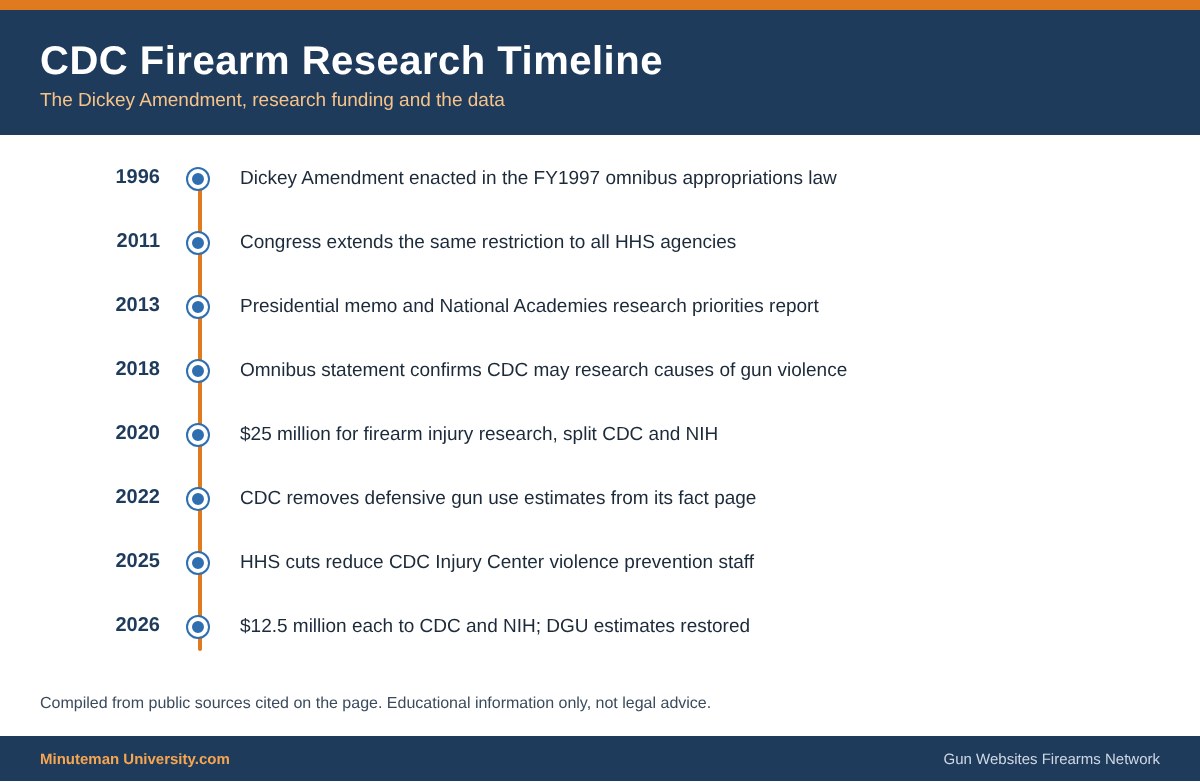
That contest centers on the Dickey Amendment, named for Rep. Jay Dickey of Arkansas and enacted in the fiscal year 1997 omnibus appropriations law (Pub. L. 104-208) in 1996. It provides that CDC injury-prevention funds may not be used “to advocate or promote gun control.” Congress also redirected $2.6 million, the amount the CDC had spent on firearm research the prior year, to traumatic brain injury studies. The background of the 1996 hearings and the physicians who testified is covered on the 2A Doctors page, and the statute itself on the Dickey Amendment page.
Each side reads the history differently. Supporters of the amendment argue it kept a federal health agency from funding one-sided policy advocacy with taxpayer money. Critics argue it discouraged legitimate research for years even though the text never banned research outright. Congress addressed that point in the March 2018 omnibus, whose explanatory statement noted the CDC “has the authority to conduct research on the causes of gun violence.” In the FY2020 budget Congress funded firearm injury research for the first time in more than two decades, $25 million split between the CDC and NIH, and it provided $12.5 million to each agency again in FY2026. The Dickey language remains in the law.
A second dispute concerns defensive gun use. In 2022 the CDC removed from its firearm fact page a range of 60,000 to 2.5 million defensive gun uses per year, drawn from a 2013 National Academies report commissioned at CDC’s request, after a 2021 meeting with gun-control groups later documented in public-records requests. By August 2026 the agency had restored the original text, which notes that estimates “vary depending on the questions asked.” The wide range itself reflects a real methodological disagreement between crime-victimization surveys and general population surveys.
Key Facts
- 1996: Dickey Amendment enacted in the FY1997 omnibus; still carried in annual appropriations.
- 2011: Congress extends the same restriction to all HHS agencies, including NIH.
- January 2013: A presidential memorandum directs the CDC to research the causes and prevention of gun violence; the 2013 National Academies report “Priorities for Research to Reduce the Threat of Firearm-Related Violence” follows.
- March 2018: Omnibus explanatory statement confirms the CDC may research causes of gun violence.
- FY2020: $25 million appropriated for firearm injury research, $12.5 million each to CDC and NIH. FY2026: $12.5 million each.
- April 2025: HHS reductions in force cut large parts of the CDC Injury Center’s violence prevention staff, according to news reports.
- 2024 data: CDC WONDER records 44,447 firearm deaths: 27,593 suicides (62 percent), 15,364 homicides (35 percent), and about 3 percent accidents, law enforcement and undetermined.
- August 2026: The CDC restores defensive gun use estimates to its “About Firearm Injury and Death” page.
What Gun Owners Should Know
- The CDC’s main data tools are public. CDC WONDER and WISQARS show death counts by intent, state and year, and the National Violent Death Reporting System adds circumstances. Checking a statistic against the original table is the strongest response to a misquoted number.
- “Gun deaths” totals combine suicides, homicides, accidents and police shootings. Suicides are the majority. Ask which category a cited figure covers. See Firearm Deaths.
- Anyone in crisis, or worried about someone, can call or text 988 to reach the 988 Suicide and Crisis Lifeline. Temporary voluntary storage with a trusted friend or range is a lawful option in many states; see Suicide and Guns.
- Defensive gun use is hard to measure, and both low and high estimates have documented limits. Cite the source and its method rather than a single number.
- Federal research funding is set each year in appropriations bills. Public comment and contact with congressional offices are the lawful ways to influence it.
- For safe-handling practice and training resources, see After Action.net; to test firearm-safety knowledge, try Tactical Quiz.com.
Sources
- CRS In Focus IF11371: Funding Restrictions on Gun Violence Research
- CDC: About Firearm Injury and Death
- Pew Research Center: What the Data Says About Gun Deaths in the U.S. (April 2026)
- The Reload: CDC Restores Defensive Gun Use Estimates (August 2026)
- National Academies: Priorities for Research to Reduce the Threat of Firearm-Related Violence (2013)