2A Pre-History: The English and Colonial Roots of the Second Amendment
The Second Amendment, ratified on December 15, 1791, did not create a new idea. It wrote down a right that English subjects and American colonists had argued over for six centuries: the duty and the right of ordinary people to keep arms, both for the common defense and for their own. Knowing that history matters today because the Supreme Court now judges gun laws by it. Since District of Columbia v. Heller (2008) and NYSRPA v. Bruen (2022), courts ask whether a modern law fits the nation’s historical tradition of firearm regulation, and much of that tradition starts in England.
The thread begins with obligation. Henry II’s Assize of Arms of 1181 required free men to keep specified arms according to their wealth, and the Statute of Winchester of 1285 continued that system of an armed populace responsible for keeping the peace. Over the 1600s the question shifted from duty to protection against the crown. After Stuart kings used militia laws to disarm political opponents, Parliament’s Bill of Rights of 1689 listed the disarming of Protestant subjects among the grievances against James II and declared that “the Subjects which are Protestants may have Armes for their Defence Suitable to their Conditions and as allowed by Law.” William Blackstone’s Commentaries (1765 to 1769) later described this as an auxiliary right supporting “the natural right of resistance and self-preservation.”
The colonies carried the militia tradition across the Atlantic. Beginning in the 1600s, colonial laws in Virginia, Plymouth, Massachusetts Bay and elsewhere commonly required free men to own a firearm and ammunition and to muster for militia duty. Attempts by British authorities to seize colonial powder and arms, most famously the march on Lexington and Concord on April 19, 1775, made the issue a cause of the Revolution. Once independent, the new states wrote it into their first declarations of rights, and James Madison drew on those texts when he proposed the amendments that became the Bill of Rights on June 8, 1789. Historians and judges still debate how much weight to give the militia language versus the individual-defense language; in Heller the majority read the right as individual, while the dissent emphasized the militia context. Both sides rely on the same founding-era record summarized here.
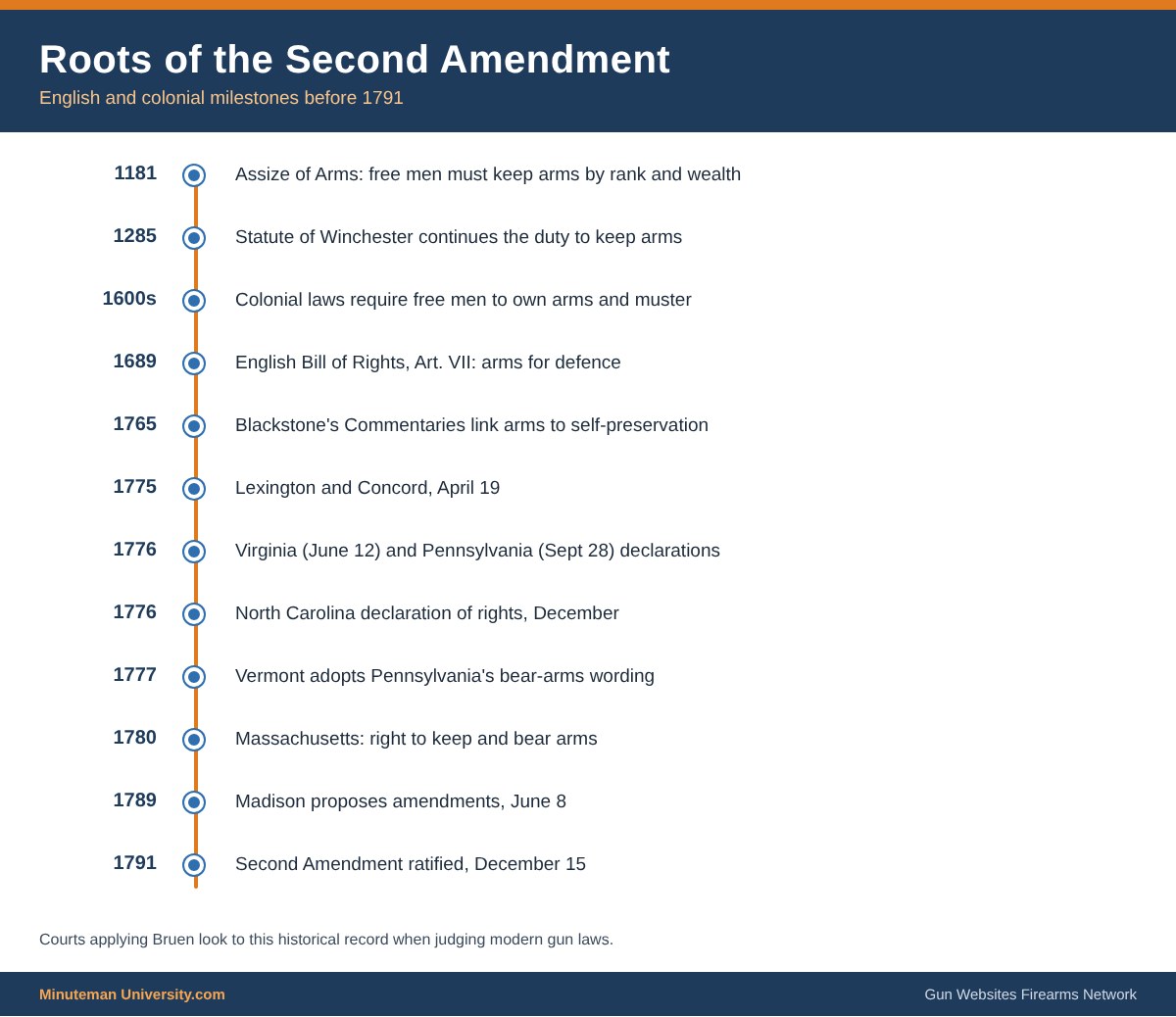
Key Facts
- 1181: Assize of Arms requires English free men to keep arms suited to their rank and wealth.
- 1285: Statute of Winchester continues the duty of men to keep arms and help keep the peace.
- 1689: English Bill of Rights, Article VII, protects arms for Protestant subjects “as allowed by Law.”
- 1765 to 1769: Blackstone’s Commentaries describe the right to have arms as part of self-preservation; widely read by American lawyers.
- April 19, 1775: Lexington and Concord, triggered by an effort to seize colonial military stores.
- June 12, 1776: Virginia Declaration of Rights, Section 13, calls a well-regulated militia “composed of the body of the people” the natural defense of a free state.
- September 28, 1776: Pennsylvania’s Declaration of Rights: “the people have a right to bear arms for the defence of themselves and the state.”
- December 1776: North Carolina declares the people’s right to bear arms “for the defence of the State.” Vermont (1777) copies Pennsylvania’s wording.
- 1780: Massachusetts: “The people have a right to keep and to bear arms for the common defence.”
- June 8, 1789: Madison introduces proposed amendments in the House; the Second Amendment is ratified December 15, 1791.
What Gun Owners Should Know
- Historical analogues now decide gun cases. Familiarity with founding-era laws helps when reading court opinions and commenting on proposed rules.
- The English right was limited by religion, class and Parliament’s will; the American versions removed those limits and placed the right in written constitutions beyond ordinary legislation.
- Many state constitutions protect the right in their own words, sometimes more broadly than the federal text. See State 2nd Amendments.
- Continue the story with The 2nd Amendment, the Militia Acts of 1792 and the Court Cases page.
- Key anniversaries, from Lexington and Concord to Bill of Rights Day, are tracked at Gun Calendars.com, and the wider history of the network is at Gun Websites.com.
Sources
- English Bill of Rights 1689 (Yale Avalon Project)
- District of Columbia v. Heller, 554 U.S. 570 (2008), majority opinion (Cornell LII)
- Pennsylvania Declaration of Rights and Constitution, 1776 (Teaching American History)
- Virginia Declaration of Rights, 1776 (Yale Avalon Project)
- The Bill of Rights: A Transcription (National Archives)