EMS & Guns: Carry Laws, Patient Firearms and Bleeding Control
Emergency medical services (EMS) personnel meet firearms in three ways: as people who may want to carry for their own protection, as caregivers who regularly treat patients who are armed, and as the medical response to gunshot wounds. Each raises different legal and practical questions, and the answers depend heavily on state law and agency policy.
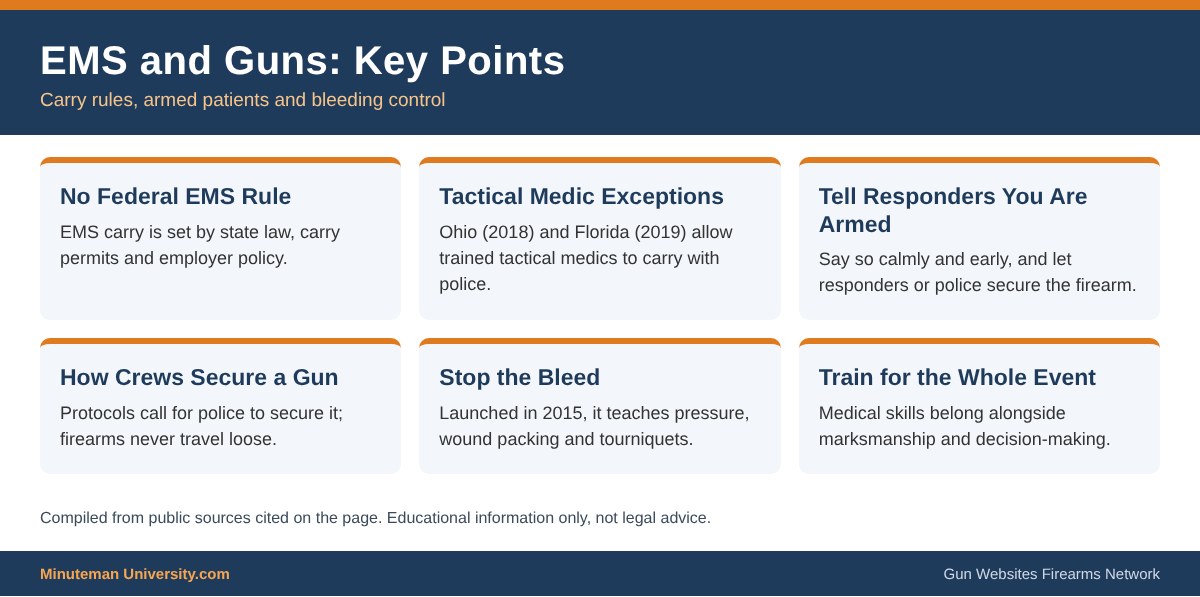
Whether an EMT or paramedic may carry a firearm on duty is mostly a matter of employer policy, not a blanket law. Most EMS agencies, public and private, prohibit personnel from carrying while working, citing patient care, liability and the risk of a weapon being taken during a struggle. A few states have created narrow exceptions for tactical medics who work alongside police SWAT teams. Ohio’s House Bill 79 (2018) allows tactical medical professionals trained in a recognized tactical program to carry on duty when authorized by their law enforcement agency, and a 2019 Florida law allows trained paramedics with a concealed weapons license to carry when supporting law enforcement in high-risk operations. Proposals elsewhere, such as a 2021 North Carolina House bill for tactical paramedics, show the issue continues to come up.
Arguments run both ways. Supporters point to assaults on EMS crews and the fact that medics often arrive at volatile scenes before police are secured. Critics, including many agency administrators, worry about liability, the added training burden and that an armed medic may be seen as a threat rather than a caregiver. The middle ground in many areas is better scene-safety protocols, body armor and close coordination with law enforcement.
For everyday gun owners, the most useful EMS-related skill is bleeding control. The Stop the Bleed campaign, launched by the White House in October 2015 and now run by the American College of Surgeons, teaches civilians to apply direct pressure, pack wounds and use tourniquets. Uncontrolled bleeding is a leading preventable cause of death after traumatic injury, and a trained bystander can act in the minutes before EMS arrives.
Key Facts
- No federal EMS carry rule: carry by EMS personnel is governed by state law, state carry permits and employer policy.
- Ohio: HB 79 (2018, signed by Gov. John Kasich) allows trained tactical medics to carry on duty with law enforcement agency authorization.
- Florida: a law effective July 1, 2019 allows trained paramedics with a concealed weapons license to carry while supporting law enforcement in high-risk incidents, subject to agency policy.
- Tactical EMS: the Tactical Emergency Casualty Care (TECC) guidelines, maintained by the Committee for Tactical Emergency Casualty Care (C-TECC), adapt military combat casualty care to civilian high-threat incidents.
- Stop the Bleed: launched October 2015; the American College of Surgeons runs the training program under a license from the Department of Defense, which holds the trademark.
- Workplace laws: many states have “parking lot” laws allowing employees with permits to store firearms in personal vehicles at work; these may or may not cover EMS stations or public agencies.
What Gun Owners Should Know
- Tell responders you are armed. If you need EMS while carrying, say so calmly and early, and let responders or police secure the firearm. Do not reach for it.
- How EMS typically handles a patient’s firearm: agency protocols generally direct crews to have law enforcement secure the weapon. If that is not possible, a trained crew member keeps fingers off the trigger, keeps the muzzle in a safe direction and leaves the gun in its holster when it can be removed that way. Firearms should not travel loose in the ambulance or to the hospital.
- EMS professionals who carry off duty should know their agency policy, any state law on carrying in vehicles or medical facilities, and the hospital’s own rules. See Gun Free Zones.
- Take a bleeding-control class. A Stop the Bleed course takes a few hours. Carry a tourniquet and pressure dressing on the range and in the vehicle.
- Train for the whole event. Medical skills belong alongside marksmanship and decision-making. Find courses through After Action.net and review Firearm Safety.
- Check state law: see State Firearm Laws and ask questions at Ask Gun Questions.com.