Firearms Research: A Guide to the Minuteman University.com Research Section
The Firearms Research section of Minuteman University.com collects reference material that gun owners and Second Amendment advocates use to understand the law, the courts, the industry and the debate. Each child page goes deeper on one subject; this hub explains what is in the section and how to judge the research and data cited anywhere in the gun debate.
The legal pages cover Federal Laws, Court Cases (Supreme Court and circuit decisions, from Cruikshank through Heller and McDonald), Firearm Bans, 50 States of 2A (state-by-state links) and Campus Carry. Practical pages include CCW Insurance for concealed carriers. Advocacy and industry pages include Opinion of 2A Organizations, the Firearm Industry Timeline and Firearm Collectors, and Hacking 2A covers practical ways to put research to work for the cause.
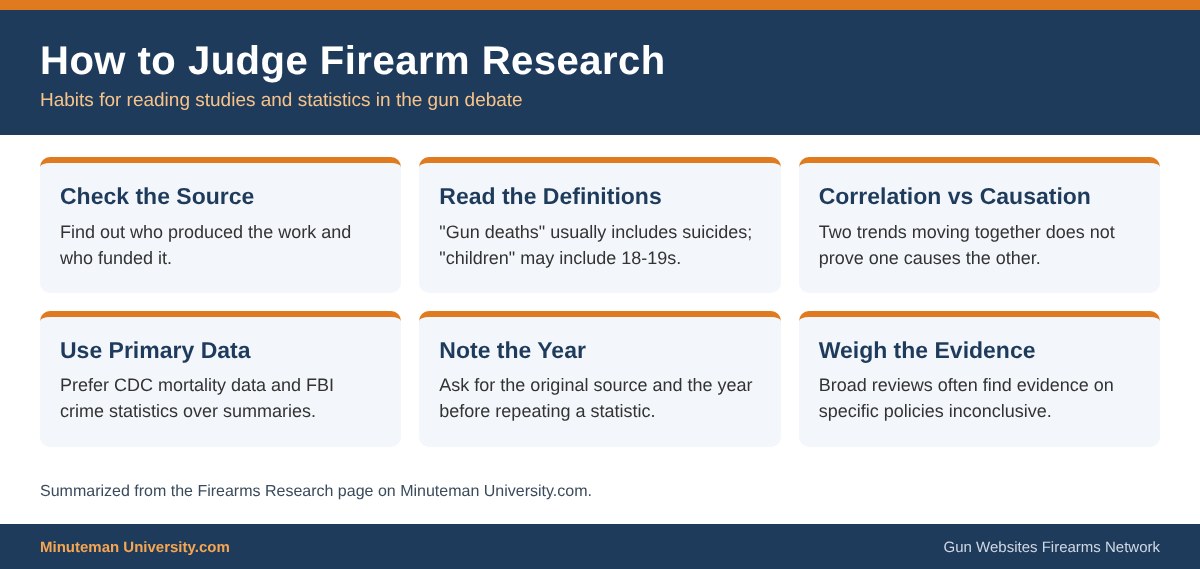
Firearm research is one of the most contested areas of social science, and studies are often quoted without context. A few habits help any reader. Check who produced the work and who funded it. Look at the definitions: “gun deaths” usually includes suicides, which are the majority of U.S. firearm deaths, and “children” sometimes includes 18- and 19-year-olds. Separate correlation from causation. Prefer primary data, such as CDC mortality data and FBI crime statistics, over secondhand summaries, and note the year of the data. Reviews that grade the strength of evidence across many studies, such as RAND’s Gun Policy in America project and the National Research Council’s 2004 review, often find that the evidence on many specific policies is limited or inconclusive, a point both sides of the debate sometimes overlook.
Key Facts
- 2004: The National Research Council’s Firearms and Violence: A Critical Review found the evidence base insufficient to draw firm conclusions about many gun policies.
- Ongoing: RAND’s Gun Policy in America project rates the strength of evidence for common gun policies and updates its reviews periodically.
- January 2023: The University of Wyoming College of Law launched its Firearms Research Center, a nonpartisan center focused on firearm law and history.
- Primary data: CDC WONDER provides U.S. mortality data by cause, including firearm suicides and homicides; the FBI publishes national crime statistics through its Crime Data Explorer.
- Legal framework: Since Bruen (June 23, 2022), courts judge gun laws by text, history and tradition, which has made historical research central to Second Amendment litigation.
What Gun Owners Should Know
- When a statistic is quoted, ask for the original source, the year and the exact definition before repeating it.
- Distinguish suicide, homicide, accident and police-involved deaths; see Firearm Deaths for context.
- Use Correlation vs Causation in the Gun Debate Library before debating a study.
- For law questions, read the statute or court opinion itself; secondary summaries, including this site’s, are educational, not legal advice.
- Test your knowledge at Tactical Quiz.com and follow 2A history dates at Gun Calendars.com.