US Wars: The Service Arms That Defined Each Conflict
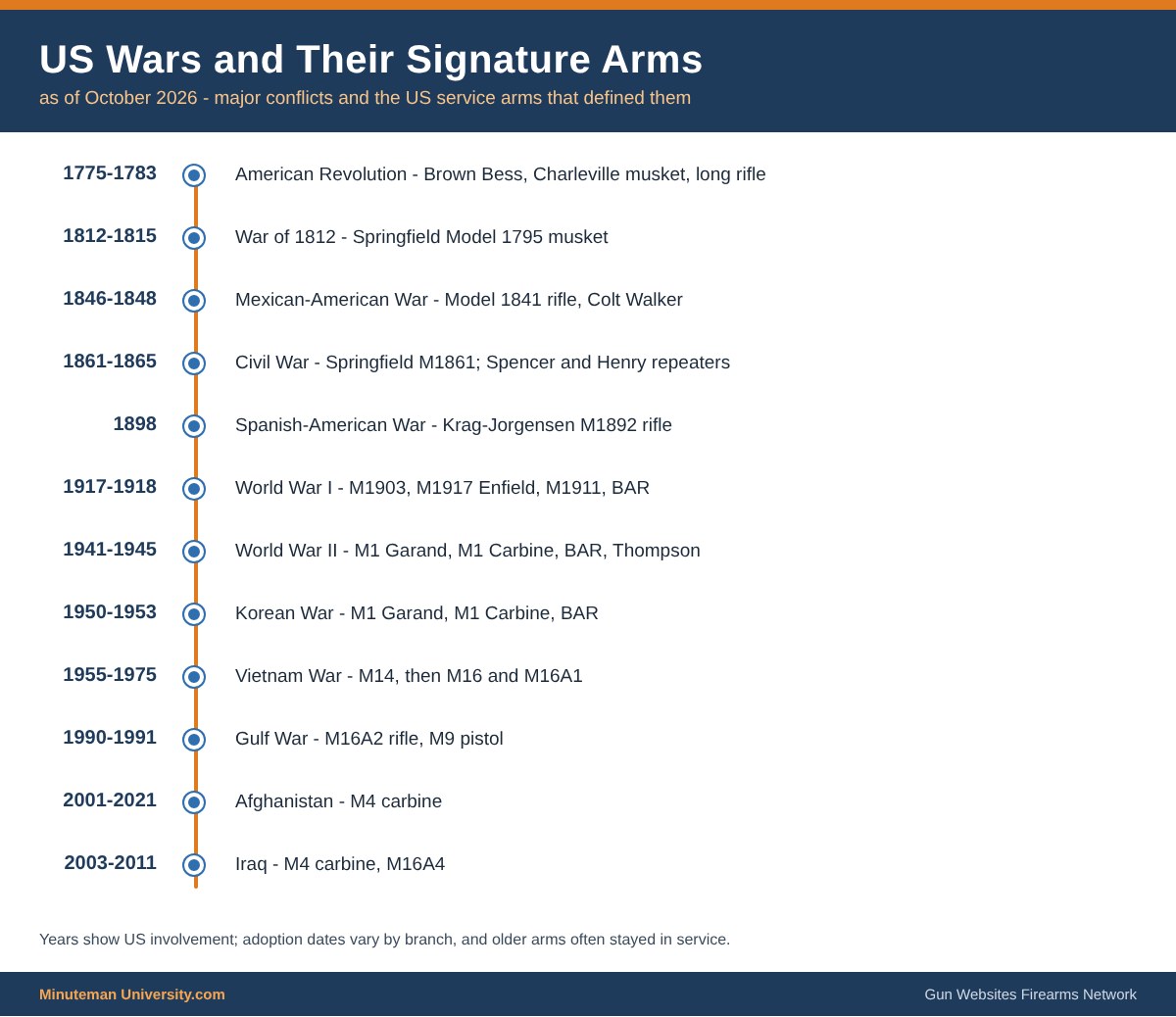
From the first shots of 1775 to the long deployments in Afghanistan and Iraq, each major American war has been fought with a recognizable set of service arms. Those rifles, pistols and automatic weapons track the technology of their era: flintlock smoothbores, rifled muskets, bolt-action repeaters, semi-automatic rifles and select-fire carbines. Many of them later passed into civilian hands as surplus, collector pieces or the commercial designs that followed them.
The link between military arms and civilian ownership runs through the militia tradition. The Militia Act of 1792 required enrolled citizens to provide themselves with a musket or rifle, ammunition and accoutrements. The Militia Act of 1903 (the “Dick Act”) reorganized the militia into the organized National Guard and the unorganized militia, two classes still defined in federal law at 10 U.S.C. 246. The same year, Congress created the National Board for the Promotion of Rifle Practice to train civilians in marksmanship; its successor, the Civilian Marksmanship Program (CMP), became a federally chartered nonprofit corporation under the National Defense Authorization Act for Fiscal Year 1996 and still sells surplus M1 Garands and, since 2018, M1911 pistols.
Military service also shaped the shooting culture itself. The National Rifle Association was founded in 1871 by Union veterans to improve marksmanship after the Civil War, and generations of veterans came home familiar with the M1911, the M1 Garand and, later, the AR-pattern rifle. Commercial versions of these designs remain among the most common civilian firearms in the country. For deeper coverage of the AR-15 and its military cousins, see AR15 Buyers Guide.com; for dated anniversaries, see Gun Calendars.com.
One caution for anyone writing about this history: an adoption year marks when an arm was officially accepted, not when every soldier carried it. Older arms often stayed in service well into a war. In 1898 many volunteer units still carried the .45-70 Trapdoor Springfield, and in World War I more American troops carried the M1917 Enfield than the M1903 Springfield.
Key Facts
- 1775–1783: Continental forces relied largely on the British Brown Bess and the French Charleville musket, with American long rifles used by rifle companies.
- 1794–1795: Springfield Armory began producing muskets; the Model 1795 became the first standard US-made service musket and served in the War of 1812.
- 1861: The Springfield Model 1861 rifle-musket became the most widely used Union long arm; Spencer and Henry repeaters saw growing use.
- 1892: The Krag–Jørgensen became the first US service rifle designed for smokeless powder, used in the Spanish-American War.
- 1903: The M1903 Springfield bolt-action rifle was adopted, the same year as the Dick Act.
- March 29, 1911: The M1911 .45 pistol was adopted; it served as the standard sidearm until the M9 replaced it in 1985.
- January 9, 1936: The M1 Garand became the first semi-automatic rifle adopted as the standard US infantry arm.
- October 22, 1941: The M1 Carbine was standardized.
- 1957 and 1967: The M14 was adopted in 1957; the M16A1 was standardized in 1967 after the XM16E1 reached Vietnam.
- 1994: The M4 carbine was adopted and became the signature arm of Afghanistan and Iraq.
- April 2022: The Army selected SIG Sauer under the Next Generation Squad Weapon program (XM7 rifle).
What Gun Owners Should Know
- Select-fire military arms are machine guns under the National Firearms Act. Civilians may possess only those lawfully registered before May 19, 1986 (18 U.S.C. 922(o)).
- Semi-automatic commercial versions of the M1 Garand, M1 Carbine, M14 and AR-15 are standard Title I firearms in most states, but some states restrict certain models. See State Gun Bans.
- Firearms made more than 50 years ago qualify as curios or relics (27 CFR 478.11), and collectors can apply for a Type 03 Collector of Curios and Relics license.
- CMP surplus sales require proof of citizenship, membership in a CMP-affiliated club and marksmanship participation. Check current eligibility rules with the CMP before ordering.
- In District of Columbia v. Heller (2008), the Supreme Court held that the Second Amendment protects an individual right that does not depend on militia service. The militia history above is context, not a condition of the right. See Court Cases.
- Content creators should give adoption years and service periods separately and cite primary sources such as the Springfield Armory National Historic Site. Test what you know at Tactical Quiz.com.
Across the Gun Websites Network
- Military Surplus Rifles Rifle Buyers Guide.net
- Rifle Timeline Rifle Buyers Guide.net
- Military Ammo Ammo Buyers Guide.com