Buying Guns: Where It Stands in 2026
Buying a firearm in the United States is shaped by three layers of law: federal rules that apply everywhere, state laws that range from minimal to highly restrictive, and local rules in some cities. This section of Minuteman University.com walks through each step a buyer is likely to meet, from the Form 4473 and the background check to permits, rosters, magazine limits and the special rules for NFA items, antiques and primitive weapons.
At the federal level, a purchase from a licensed dealer requires the buyer to complete ATF Form 4473 and pass a check through the FBI’s National Instant Criminal Background Check System (NICS), which went live on November 30, 1998 under the Brady Act. Demand remains high: the NSSF-adjusted NICS count, an industry estimate of retail gun sales, was 14,612,314 in 2025, down 4.1% from 2024. Federal law lets licensed dealers sell long guns to buyers 18 and older but handguns only to those 21 and older. The Fifth Circuit struck down that handgun age limit in January 2025 for Louisiana, Mississippi and Texas, the Fourth Circuit upheld it, and on June 30, 2026 the Supreme Court declined to hear the age cases, leaving the split in place.
State law is where buyers see the most variation. Some states require a permit or license before purchase, keep approved handgun rosters, limit magazine capacity, ban certain rifles or ration purchases. Others add little to federal law. The Supreme Court is set to hear challenges to state and local bans on AR-15-type rifles on December 2, 2026, a case that could reshape several pages in this section.
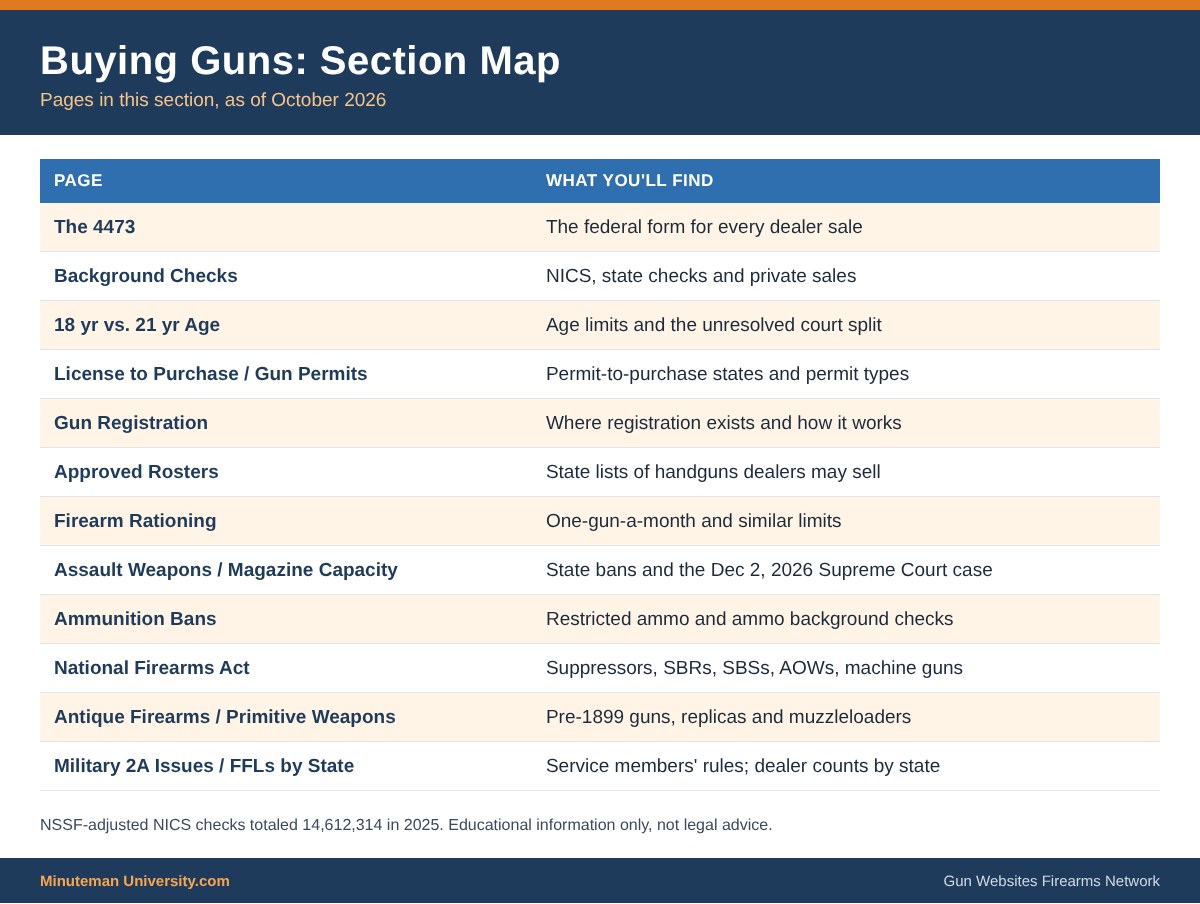
Pages in This Section
- The 4473: the federal transaction form every dealer purchase requires.
- Background Checks: NICS, state points of contact and private sale rules.
- 18 yr vs. 21 yr Age: federal and state age limits and the court split.
- License to Purchase: states that require a permit or ID card before buying.
- Gun Permits: purchase, possession and carry permits compared.
- Gun Registration: where registration exists and how it works.
- Approved Rosters: state lists of handguns that dealers may sell.
- Firearm Rationing: one-gun-a-month and similar purchase limits.
- Assault Weapons: state bans and the pending Supreme Court case.
- Magazine Capacity: state limits on magazine size.
- Ammunition Bans: restricted ammunition types and ammo background checks.
- National Firearms Act: suppressors, SBRs, SBSs, AOWs and machine guns.
- Antique Firearms: pre-1899 guns and replicas under federal law.
- Primitive Weapons: muzzleloaders and other traditional arms.
- Military 2A Issues: buying and owning guns as a service member.
- FFLs by State: how many licensed dealers each state has.
What Gun Owners Should Know
- Answer every Form 4473 question truthfully; a false answer is a federal felony even if the sale is denied.
- Buying a gun for someone who cannot legally buy it (a straw purchase) is a serious federal crime.
- A delayed NICS response is not a denial; federal law lets the dealer proceed after three business days, though some states and dealers wait longer.
- Check state law before buying across state lines. Handguns must be transferred through a dealer in the buyer’s home state.
- Questions about a specific purchase can be posted at Ask Gun Questions.com.
Sources
- FBI: National Instant Criminal Background Check System
- NSSF-Adjusted NICS Background Checks for 2025
- US Supreme Court Turns Away Cases Testing Firearm Age Restrictions (June 30, 2026)
- 18 U.S.C. 922, Unlawful Acts (Cornell LII)
- the 4473
– 18 yr vs. 21 yr Age
– Felons & Guns
– Marijuana & Guns - NICS – 1998
- Background Checks
- License to Purchase
- Approved Rosters
- Ammunition Bans
- Magazine Capacity
- Assault Weapons
- Undetectable Firearms Act
- 80% Firearm Kits
- Ghost Guns
- 3D Printed Guns
- Antique Firearms & Primitive weapons
- Smart Guns