1897
Merchant seamen case with an early Supreme Court remark (dicta) on concealed weapons
- Robertson v. Baldwin
- the case concerned merchant seamen; its remark that laws prohibiting the carrying of concealed weapons do not infringe the right to bear arms was dicta
- its mention of concealed weapons was a side remark (dicta), not a holding on concealed carry
About Robertson v. Baldwin
Robertson v. Baldwin, 165 U.S. 275 (1897), was not a firearms case. It involved merchant seamen who left their ship before the end of their contracted voyage, were arrested under federal law, and returned to the vessel. They argued that forcing them back to work amounted to involuntary servitude under the Thirteenth Amendment. In an opinion by Justice Henry Billings Brown, decided January 25, 1897, the Court rejected that claim, holding that seamen’s contracts had long been treated as a special category. Justice John Marshall Harlan dissented.
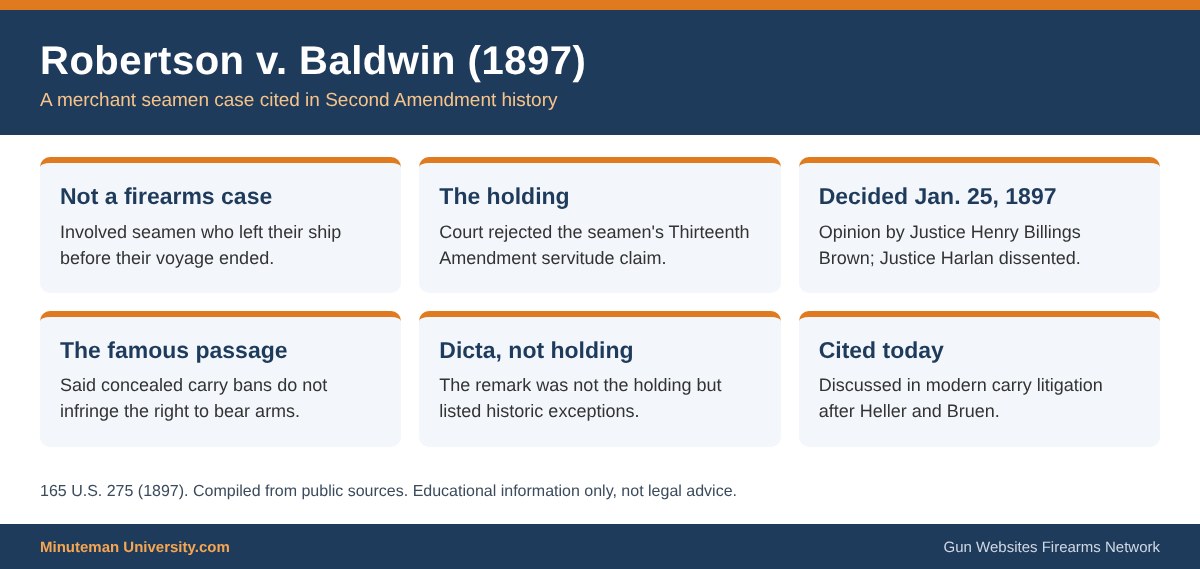
The case is cited in Second Amendment history for a passage explaining that the Bill of Rights embodied guarantees inherited from English law, which had long been subject to well-recognized exceptions. Among its examples, the Court stated that the right of the people to keep and bear arms is not infringed by laws prohibiting the carrying of concealed weapons. That remark was dicta, not the holding of the case, but it is one of the earliest Supreme Court statements treating the right to arms as a personal right alongside free speech and press. Courts and commentators have cited it in modern carry litigation, including in discussions following District of Columbia v. Heller (2008) and New York State Rifle and Pistol Association v. Bruen (2022).
Key Facts
- December 15, 1896 – Case argued before the Supreme Court
- January 25, 1897 – Decided; opinion by Justice Henry Billings Brown, with Justice Harlan dissenting
- 1897 – Opinion lists concealed carry restrictions among historic exceptions to the right to arms
- 2008 – Heller cites nineteenth-century concealed carry precedent in describing limits on the right