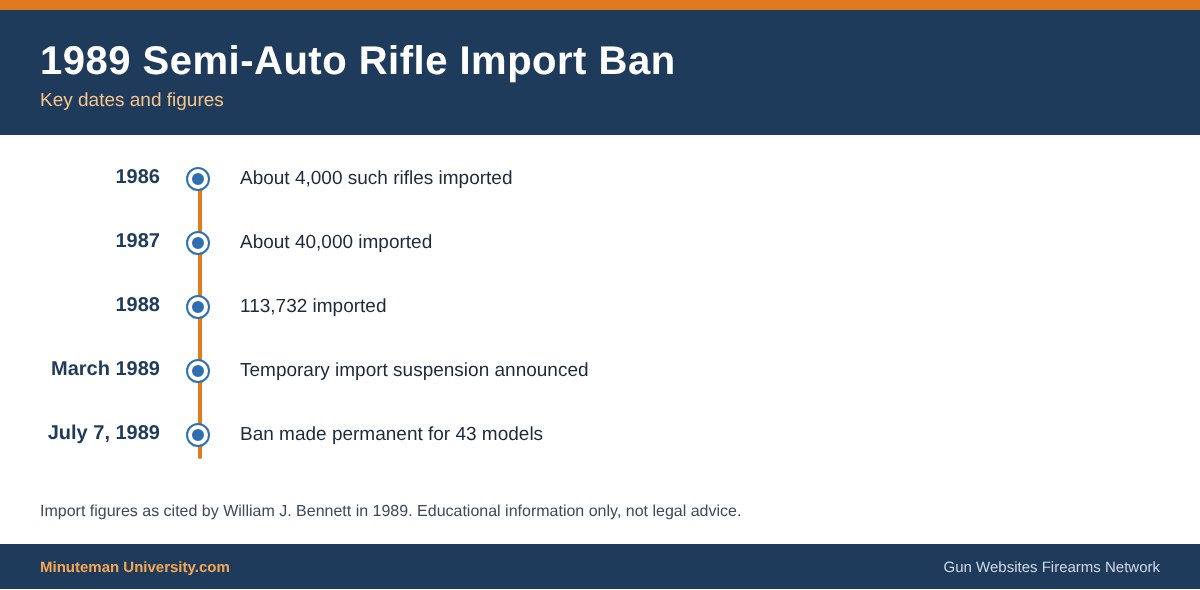
- Wed March 15, 1989 – spring suspension
- July 7, 1989 – Signed into law
- Bush Administration
- banned imports of semiautomatic assault rifles indefinitely
- announced by William J. Bennett, the director of national drug policy
- requests from importers to bring in the rifles had nearly tripled those for all of 1988
- Law enforcement officers have complained they are often outgunned by drug-traffickers and other criminals who carry high-powered weapons that fire many rounds without needing reloading.
- Doctors and nurses in major cities have reported sharp increases in the numbers of deaths and serious wounds from such weapons
- firearms dealers attributed the sharp jump in import-permit applications to a fear by the gun-owning public that purchase of the weapons soon would be prohibited
- Stephen E. Higgins, the director of the Bureau of Alcohol, Tobacco and Firearms, estimated that half the owners of assault rifles are collectors.
- The permanent ban affected all 43 of the 50 models included in the spring suspension
B
Imports cited by Bennett
- 1988 = 113,732
- 1987 = 40,000
- 1986 = 4,000
About the Semi Automatic Rifle Import Ban (1989)
The 1989 import ban was an executive branch action, not an act of Congress. The Bureau of Alcohol, Tobacco and Firearms (ATF) issued it under the Bush administration, using the “sporting purposes” test in the Gun Control Act of 1968. That test lets ATF approve imported firearms only if they are particularly suitable for, or readily adaptable to, sporting purposes. In the spring of 1989 ATF suspended import permits for semi-automatic rifles it was reviewing, putting applications for more than 700,000 rifles on hold. On June 30, 1989 the U.S. Court of Appeals for the 11th Circuit upheld the temporary suspension in the Gun South case.
On July 7, 1989, after a three-month study, ATF Director Stephen E. Higgins announced the ban was permanent. ATF grouped the affected rifles by three traits: military appearance, the ability to accept a large-capacity magazine, and being a semi-automatic version of a machine gun. About 43 models were barred from import and a handful were allowed. The ruling covered imports only, so U.S. makers could keep building similar rifles. Importers responded with “sporterized” versions. In 1998 the Clinton administration broadened the policy to 58 more designs. The 1989 decision is the origin of the import rules that still shape which foreign rifles, such as AK and FAL variants, American gun owners can buy.
Key Facts
- 1968: Gun Control Act sets the “sporting purposes” test for imported firearms
- Spring 1989: ATF suspends import permits for semi-automatic rifles under review
- June 30, 1989: 11th Circuit upholds the temporary suspension (Gun South case)
- July 7, 1989: ATF announces the import ban is permanent, barring about 43 models
- April 6, 1998: Treasury accepts a review panel’s findings extending the ban to 58 modified rifles
Sources
- ATF News Release FY-89-31 and Fact Sheet, July 7, 1989 (ATF)
- Background Briefing on Assault Weapons, April 6, 1998 (Clinton White House Archives)
Across the Gun Websites Network
- Laws about the AK47 AK47 Buyers Guide.com
- Russian Kalashnikovs AK47 Buyers Guide.com